Outdoor News Bulletin
Tight Lines: Evaluating Rainbow Trout Fishing in Oklahoma
USGS researchers at the Oklahoma Cooperative Fish and Wildlife Research Unit, biologists at the Oklahoma Department of Wildlife Conservation (ODWC), and researchers at Oklahoma State University are leading a study on rainbow trout (hereafter, trout) fishing at the lower Mountain Fork River (LMFR) below Broken Bow Dam in southeastern Oklahoma. This location is one of two year-round rainbow trout fisheries in the state and the only one with potential for a wild rainbow trout fishery.
Trout and Tourism
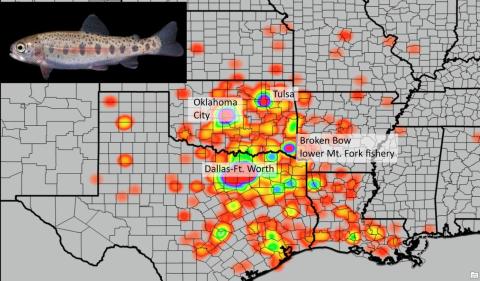
This southeastern Oklahoma fishery is a tourist destination, with approximately 75% of anglers coming from out-of-state locations, contributing to an estimated $25 million economic impact on the local economy. As a result, any changes to the management of the rainbow trout program may affect the broader economy.
Since 2004, the cost of stocking catchable-size rainbow trout has increased by 130%, prompting the ODWC to consider alternative stocking strategies. Reducing catchable-size-stocking to promote a wild fishery could lower costs, but the uncertain survival and growth of wild fish may limit fishery sustainability. Reduced hatchery stocking could also decrease angler catch rates and satisfaction.
Hooked on Trout
From July 2024 through August 2025, researchers conducted creel surveys to assess fishery conditions and angler opinions on trout stocking and the potential for a wild fishery. Over those 14 months, creel clerks interviewed 2,377 anglers.
When informed that wild trout were present, 45% of anglers reported increased interest in fishing the LMFR. In comparison, 75% reported increased interest when told the river was stocked with hatchery-reared catchable trout. Preference for hatchery-stocked fish was greater among both fly and non-fly anglers overall. However, fly anglers and more frequent LMFR anglers were significantly more likely to express increased interest in stream-raised trout, indicating a higher preference for wild trout among these groups.
Wild or Hatchery: What Anglers Really Want
Fly anglers fished about four times more than non-fly anglers, although catch rates were similar between groups. Non-fly anglers were more likely to harvest trout, while fly anglers released nearly all fish caught. Economic analyses also showed that fly anglers had a higher willingness to pay, suggesting they could continue to fish even if the trip costs increase.
Compared to previous creel surveys from the late 1980s and early 1990s, current harvest rates are much lower than when the trout fishery was first established. Anglers’ interest in harvest has declined, with satisfaction now driven more by catch rates and overall fishing experience. While catching hatchery-stocked trout remains important to most anglers, the most avid anglers would likely continue fishing at the LMFR if the ODWC shifted toward a wild fishery. If a wild fishery is pursued, further research on juvenile trout growth and survival, particularly their interaction with hatchery-stocked trout, would help guide management decisions.
The ONB features articles from Cooperative Fish and Wildlife Research Units across the country. Working with key cooperators, including the Wildlife Management Institute, Units are leading exciting, new fish and wildlife research projects that we believe our readers will appreciate reading about. This article was written by James M. Long, jmlong@usgs.gov, Unit Leader and Adjunct Professor, Oklahoma Cooperative Fish and Wildlife Research Unit, Oklahoma State University, and edited by Dawn Childs, dchilds@usgs.gov, USGS Information Specialist.