Outdoor News Bulletin
Trees Act Their Size, Not Their Age
Guiding Red Spruce Restoration in the Central Appalachians
Red spruce forests, once widespread across the central and southern Appalachians, now persist only in scattered fragments on mountaintops. Researchers are partnering with local community groups to restore the spruce forest’s structure and reconnect forest patches, creating resilient habitat for wildlife like the Virginia northern flying squirrel, while also protecting clean water, carbon storage, and outdoor recreation in the Central Appalachians.
USGS researchers with the Northeast Climate Adaptation Science Center (NE CASC) and Virginia Cooperative Fish and Wildlife Research Unit, and graduate students at Virginia Polytechnic Institute and State University (Virginia Tech) are working with the Central Appalachian Red Spruce Restoration Initiative, U.S. Forest Service, U.S. Fish and Wildlife Service, West Virginia Division of Forestry, and The Nature Conservancy to reconnect scattered, isolated red spruce forest patches into a resilient landscape corridor across the central Appalachians.
One of Appalachia’s rarest mammals, the small, nocturnal Virginia northern flying squirrel (hereafter flying squirrel) lives high in the canopy, gliding between the trees to forage on truffles found in red spruce forests. Though no longer listed as endangered, it remains a species of conservation concern because it depends entirely on spruce habitat. This makes the flying squirrel a “sentinel species,” a living signal of the forest’s health.
“The flying squirrel’s survival speaks volumes about the larger ecosystem,” says Abby McKellips, a PhD student in the Department of Forest Resources and Environmental Conservation at Virginia Tech. “If flying squirrels can thrive, that’s an indicator we’re restoring the right forest conditions.”
Last Known Remaining Old-Growth Red Spruce Forests in Appalachia
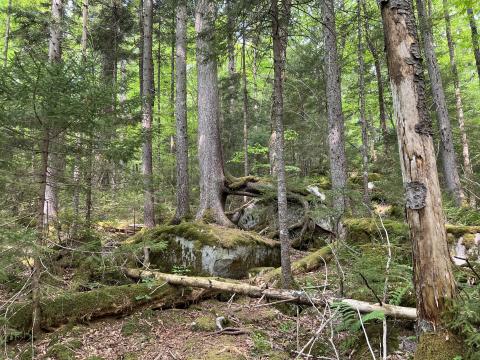
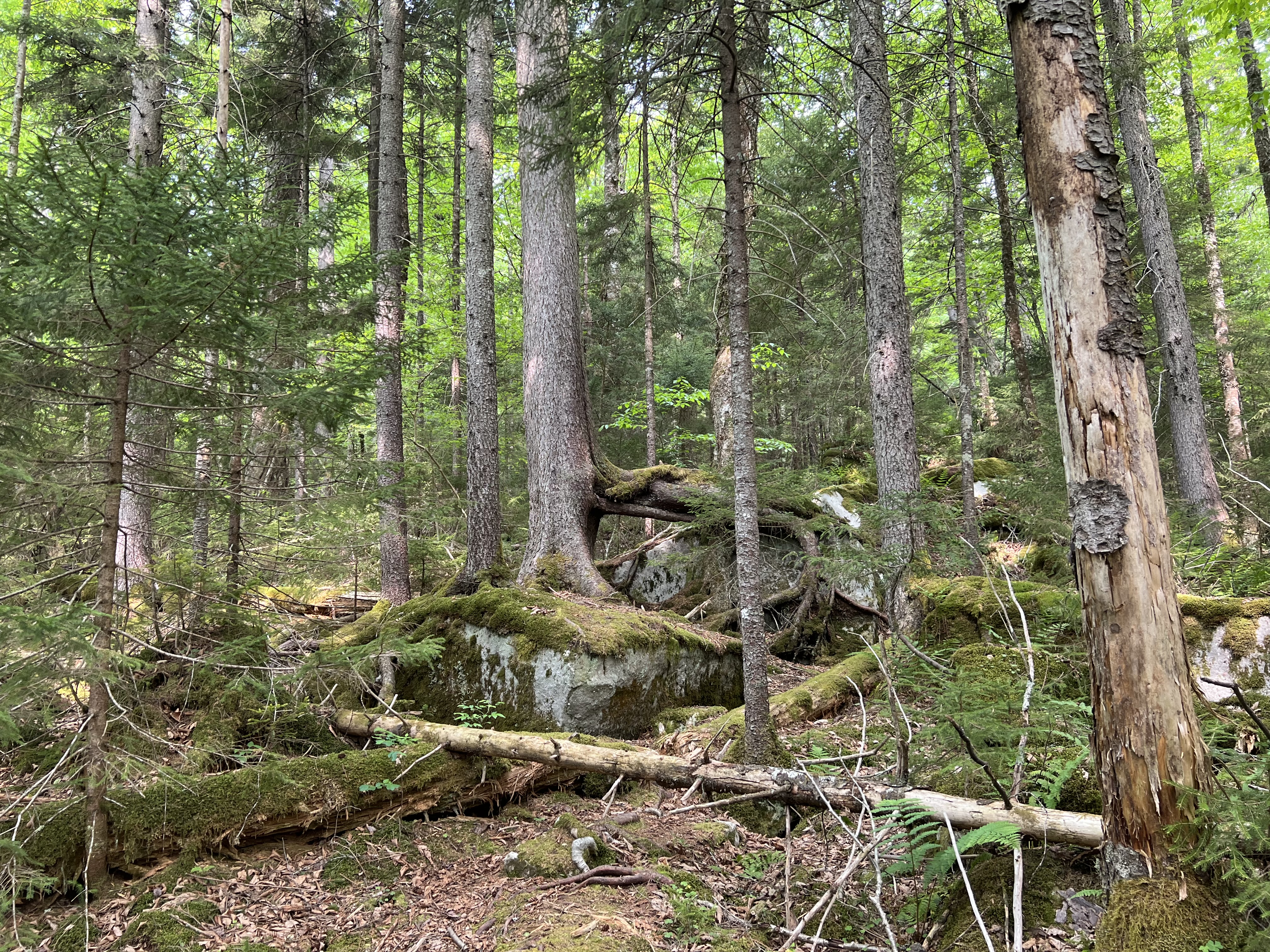
Gaudineer Knob in eastern West Virginia is home to one of the few remaining old-growth red spruce forests in the region, sitting as a unique reminder of what red spruce forests once looked like across the central and southern Appalachians. It was by a stroke of luck that the area escaped 19th-century logging thanks to a boundary error between two logging companies. About an hour southwest is Spruce Knob, the highest point in West Virginia, which offers incredible views of misty ridgelines and the unmistakable scent of spruce on cool mountain air.
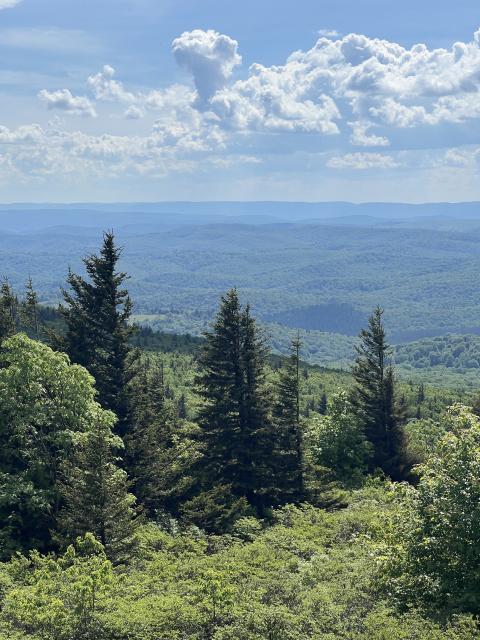
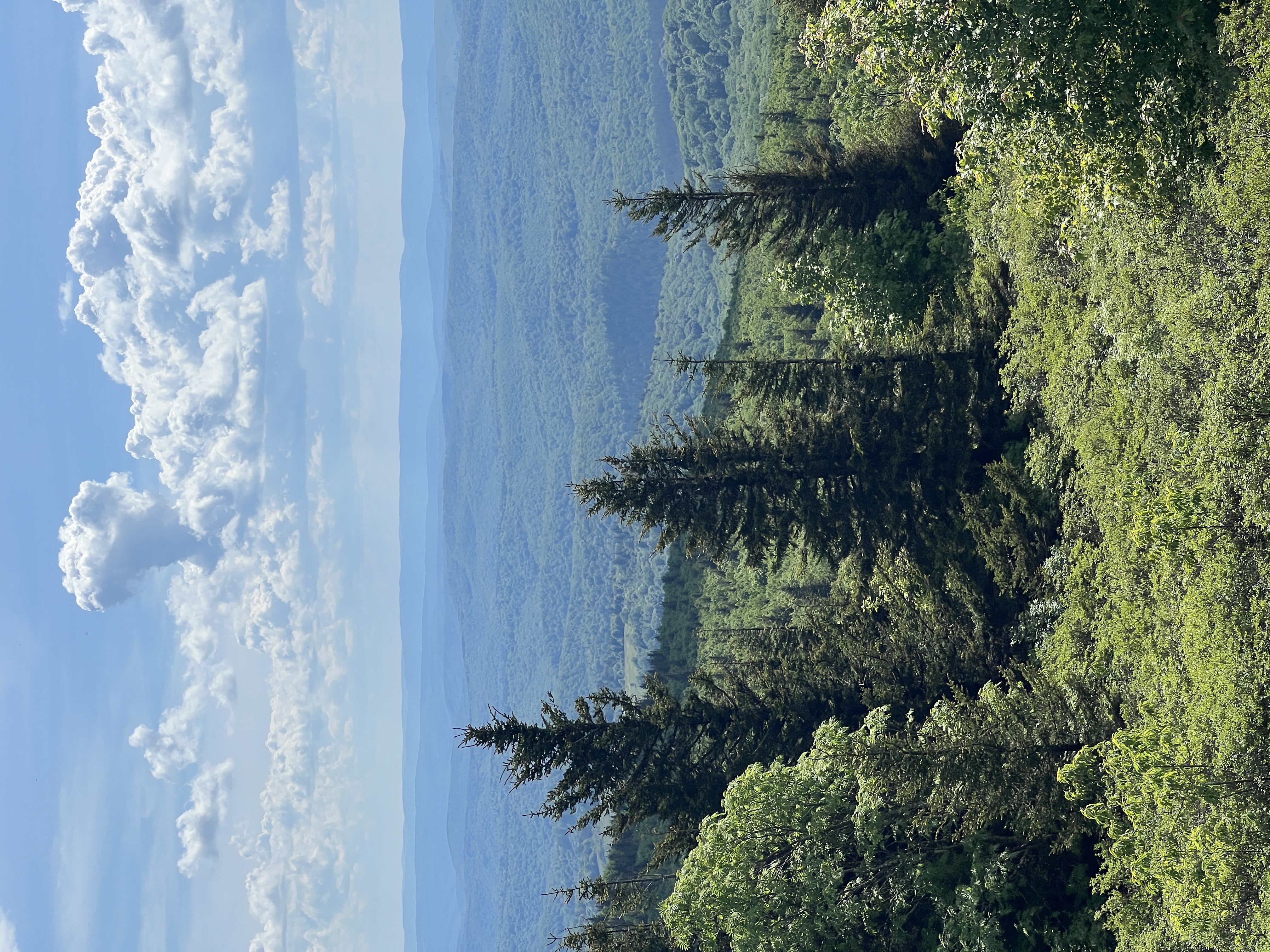
These two mountain peaks each hold an isolated fragment of red spruce forest and are part of a larger patchwork of red spruce forest stands across the central and southern Appalachians, separated from each other by miles of hardwood such as maple, oak, and beech. Pleistocene relicts of a once-continuous forest, red spruce moved over time uphill into cooler, higher elevations after the last Ice Age. Much of the spruce forest was logged at the turn of the 20th Century, and the debris left behind (logging slash) fueled widespread wildfires. Because spruce forests evolved with centuries-long gaps between wildfires, the frequent wildfires destroyed seed sources and seedlings, limiting spruce regeneration and allowing northern hardwoods to dominate. More recently, remaining forests have been impacted by changing weather, air pollution, recreation, and development. Most estimates suggest only about 10% of the central Appalachians’ spruce remains.
As the climate continues to change, there is no further upslope refuge where red spruce can move to escape warming.
Why Spruce Matters
These forests support recreational activities like hiking and hunting, providing some of the best ruffed grouse and black bear hunting in the state.
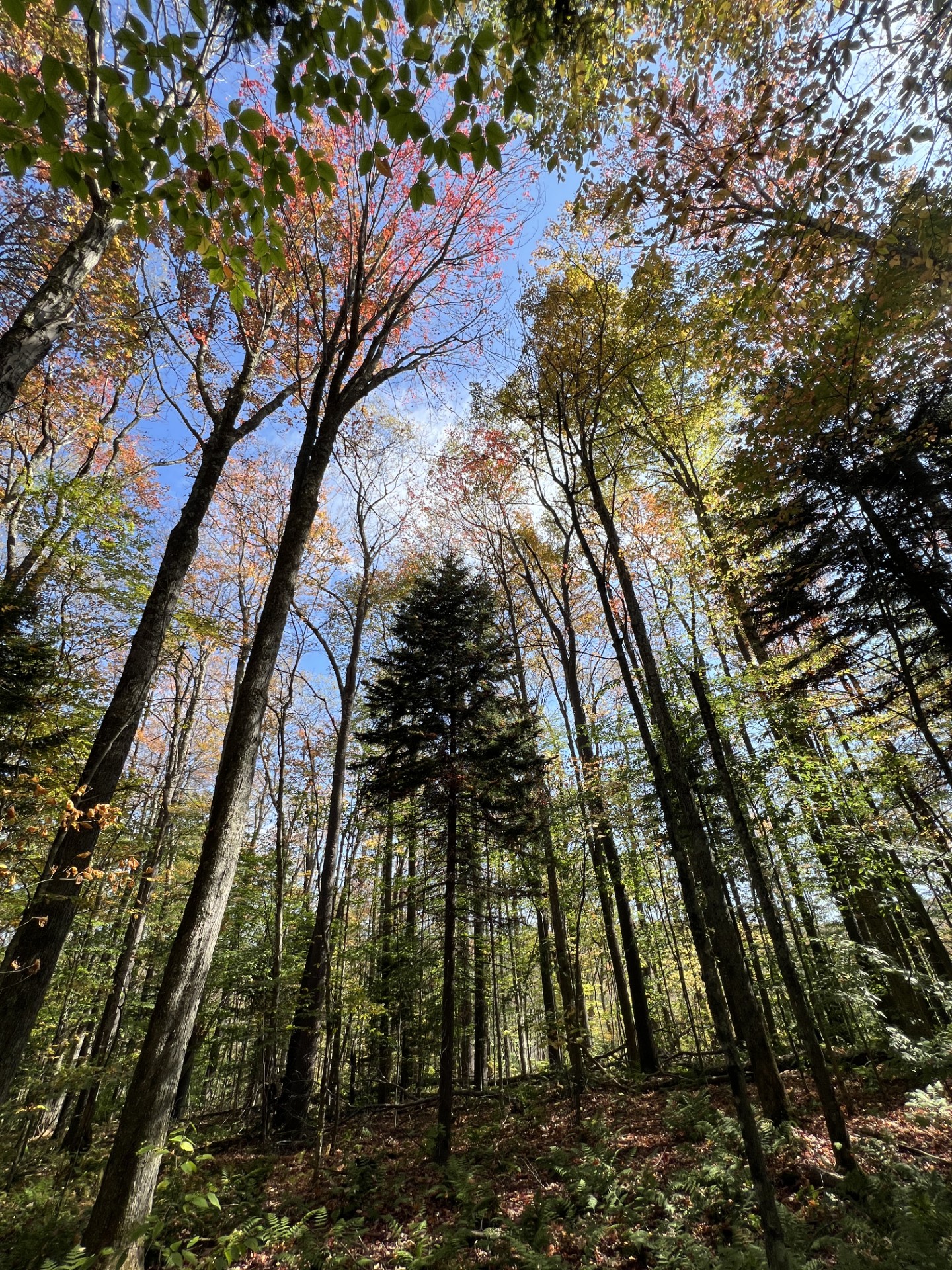
“Imagine hiking in fall, seeing a sea of orange, browns, and yellows on the mountains. Then suddenly, at the peaks, these bright pockets of green emerge. It looks like every mountain is wearing a spruce hat,” says Tanner Ray Humbert, a graduate student at Virginia Tech working on the project. “These patches are considered ‘sky islands’ because many plants and animals cannot migrate between them, so it's similar to being on an island in the ocean.”
Yet these spruce hats are more than an autumn fashion quirk on the landscape. They’re also functional.
“Their ability to hold vast amounts of water and keep it cold to recharge streams that brook trout depend on is critical,” says Humbert. Plus, they store more carbon than the surrounding hardwood forest. “It’s moss on top of moss on top of moss,” he says, “and that’s all carbon.”
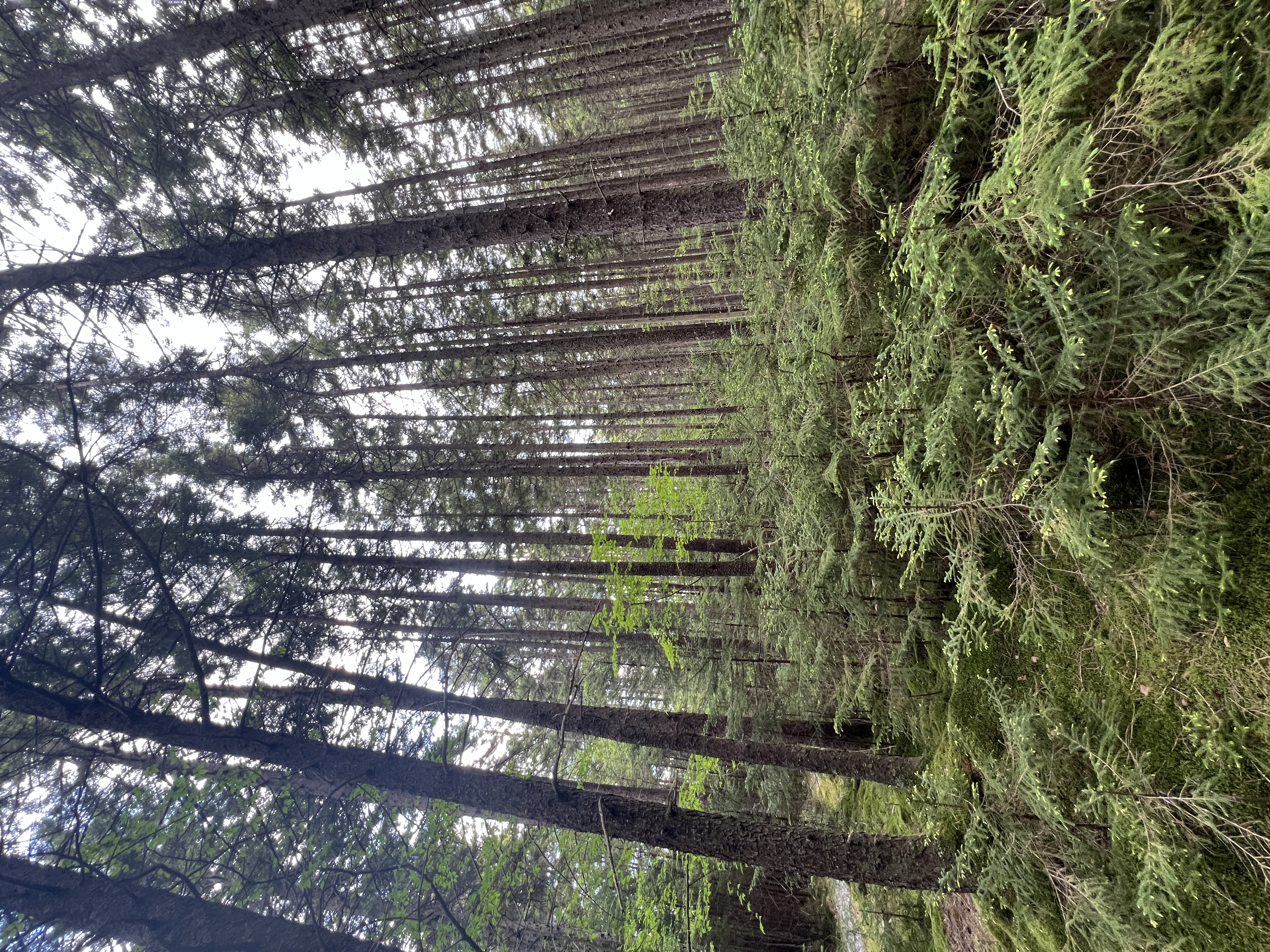
Spruce forests maintain cool, moist boreal habitats that many other species depend on, including the flying squirrel, snowshoe hare, hermit thrush, red crossbill, Cheat Mountain salamanders, and many mosses, lichens, and fungi.
Fast-Forwarding the Long Game
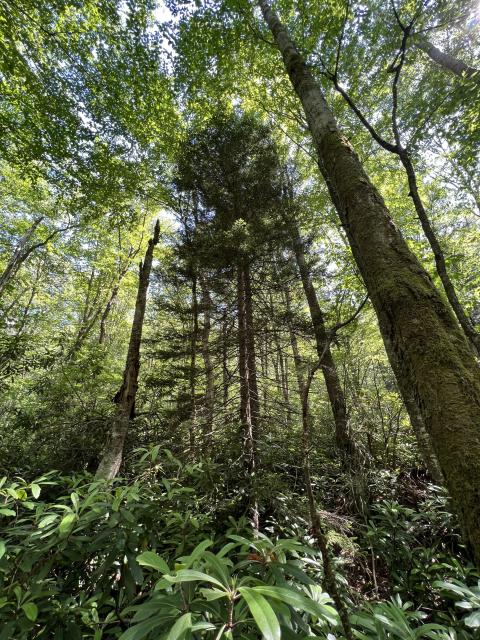
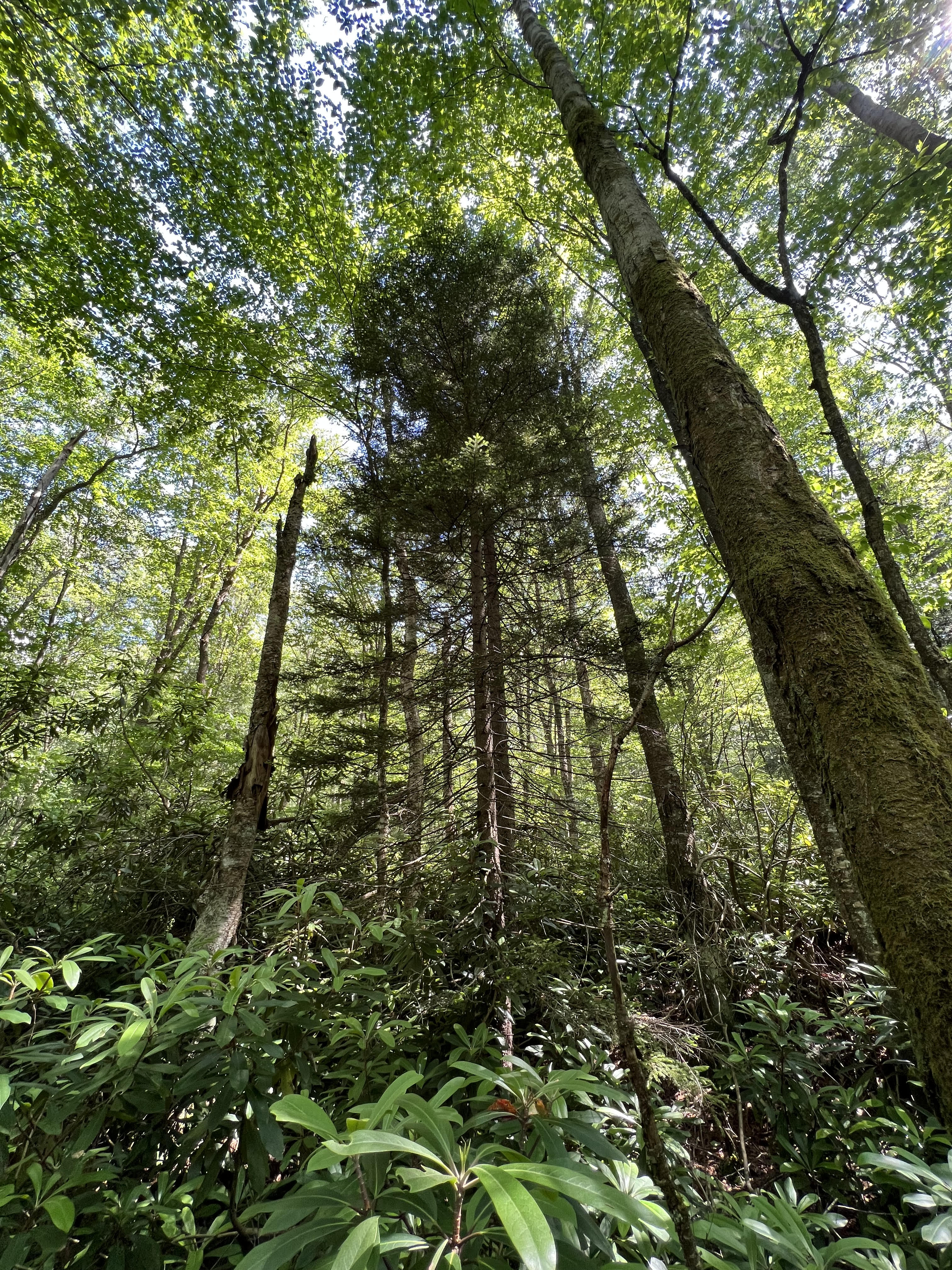
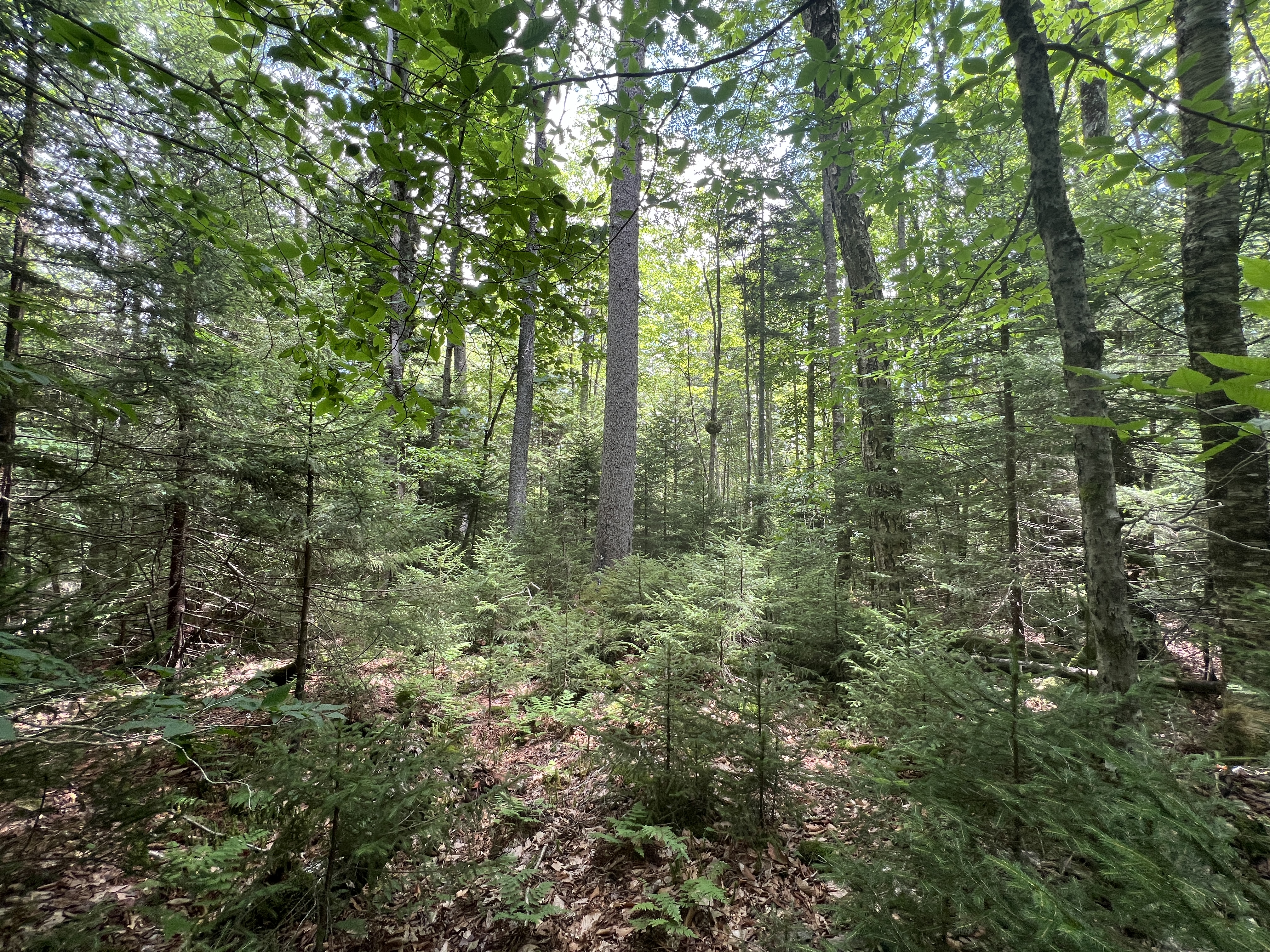
The team's restoration approach is guided by a deceptively simple idea: trees act their size, not their age. A hundred-year-old red spruce tree may stand just 20 feet tall. They can spend decades, even centuries, surviving in the understory, tolerating the shade beneath a dense hardwood canopy.
“Generally, red spruce is perfectly happy to lose the race to the top of the canopy,” says Humbert.
But once a gap opens in the canopy, caused by storm winds or human intervention, the trees can rapidly grow toward the light and fill the space. A strategy of patience.
“Unfortunately, this evolutionary adaptation works well on time scales of 500 to 1,000 years and with climate change, we don't have 500 to 1,000 years to wait for red spruce to retake dominance,” says McKellips. “Red spruce is playing the long game, but we don't have the long game (time) to play.”
Releasing Trees to Refashion a Landscape
To help red spruce, and by extension flying squirrels, the NE CASC team is focusing on restoring forest structure. Across the Monongahela National Forest and surrounding areas in West Virginia, at hundreds of forest plots, scientists measure the percentage of red spruce in the canopy, their height and diameter, and their distance to other trees. In 2007, crews cleared hardwood species surrounding target spruce trees at three intensities – a process called “competitor removal” – to open the canopy by 33%, 67%, or 100% (fully open). The scientists re-measured each plot to evaluate how the removal treatments had affected the ability of spruce to reach the upper canopy.
“We discovered that tree height and their light environment matter most. Trees act their size, not their age,” says McKellips.
“The data show that it’s not enough to thin a little; to truly release these trees, you need to open the canopy fully,” adds Humbert.
Their field data also revealed a lag. Released red spruce trees can take several years after hardwood competitors are removed to grow into the light and space of the upper canopy. Knowing about this lag may help managers create more realistic restoration timelines, estimating, for example, when a released spruce might finally reach canopy height and begin functioning as a flying squirrel habitat.
This insight is driving both on-the-ground treatments and the modeling that supports restoration planning. It’s not enough to just plant more trees. “We’re not just growing trees, we’re building structure.”
The team feeds their field data directly into two modeling tools: the Landscape Disturbance and Succession model (LANDIS-II) is a landscape-scale forest simulation model that projects forest growth and change over the next century under climate and restoration scenarios, and Least Cost Path Analysis (LCPA), a spatial tool that maps the most efficient routes for reconnecting forest fragments. Fully connected red spruce landscapes are now rare south of northern New York, and fragmented populations further south risk local extinctions and genetic bottlenecks.
Together, these approaches allow the team to ask and answer two critical questions: Where can red spruce grow in the future, and how can these forests be reconnected? These potential corridors could stretch across high elevations from West Virginia all the way through Pennsylvania, allowing flying squirrels and spruce to spread climate-adapted genes northward.
If, as Humbert describes, it looks like every mountain is wearing a spruce hat in autumn, then the goal of the project is to re-style those hats into a green scarf draped across the range.
If it looks like every mountain is wearing a spruce hat in autumn, then the goal of the project is to re-style those hats into a green scarf draped across the range.
“Connectivity is everything,” says McKellips. “This landscape-level planning is vital for long-term survival amidst changing climate and land use pressures.”
Adaptive Management in Action
“Every action feeds the model, and every model outcome guides the next steps,” says Humbert.
This adaptive management cycle helps forest managers prioritize stands for thinning or planting, based on the structural readiness of the area, choose appropriate levels of competitor removal, and estimate how long until spruce trees close the canopy and may act as squirrel habitat. They may craft realistic and hopeful strategies for restoring the Appalachian red spruce corridors and pinpoint where restoration efforts are most likely to succeed. Stakeholders can also better coordinate restoration activities across property lines where structural and species needs align.
The guiding principle—“trees act their size, not their age”—keeps the focus on creating the structure, canopy dynamics, and connectivity that can best support climate resilience and wildlife.
With the right conditions, even old trees can grow tall.
The ONB features articles from Cooperative Fish and Wildlife Research Units across the country. We believe our readers will appreciate discovering stories about the exciting fish and wildlife research projects that Unit scientists are conducting to solve real-world problems, engage graduate students in experiential learning, and deliver technical assistance to natural resource practitioners.
This story was authored by Shannon Bayliss, Oak Ridge Institute for Science and Education (ORISE) Participant with the USGS National Climate Adaptation Science Center and reviewed by Dr. Mark Ford, USGS researcher and Unit Leader at the Virginia Cooperative Fish and Wildlife Research Unit, and graduate students Abby McKellips (PhD student) and Tanner Humbert (MS student) in the Department of Forest Resources and Environmental Conservation at Virginia Tech.
This work is part of the Northeast Climate Adaptation Science Center project “Using the Virginia Northern Flying Squirrel to Guide Resilient Restoration of Red Spruce in the Central Appalachians.”
Click on images to view them larger