Outdoor News Bulletin
When the Familiar Stops Working
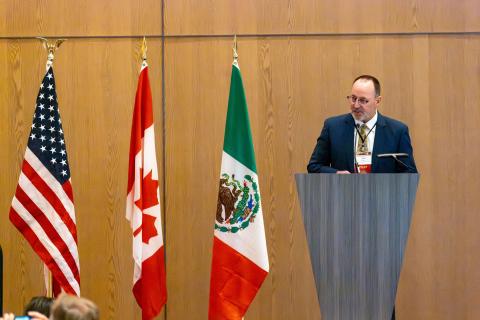
I recently stood in front of a room full of conservation professionals at the 91st North American Wildlife and Natural Resources Conference and asked a simple question: why are so many of us, right now, having the same conversation about a different conservation future? Not just at the North American, but in breakout sessions and boardrooms and hallway conversations across the country. Groups like the Property Environment Research Center (PERC), the Boone and Crockett Club, The Wildlife Society, universities, think tanks, and new efforts like Ground Shift and Nature is Nonpartisan along with many others are all simultaneously circling the same question. The conservation space is crowded with people contemplating conservation’s future as they try to plot the course for conservation’s next chapter, era, or paradigm. That kind of convergence does not happen by accident. It happens because conditions demand it.
The Honest Reckoning
People rarely reimagine the future when things are working well. It is the gap between where we are and where we want to be that creates the opening for new thinking. Leopold recognized this nearly a century ago when he explained the creation of his 1930 American Game Policy by urging for what he called a frank recognition that the present order was “radically unsatisfactory”.
I think about this the way I think about sports. When a team wins, nobody questions the roster, the coach, or the formula. But when the results stop matching the expectations, change becomes inevitable. In conservation, we have had more than fifty years of conversations about the future, yet meaningful policy development has remained largely stagnant. That disconnect between effort and outcome has grown to a point where it is impossible to ignore.
And to be clear, dissatisfaction is not cynicism. It is the honest recognition that our current trajectory is not delivering the results our profession needs. That honesty is the first step toward something meaningful.
The Rules Have Changed
The operating environment for conservation has shifted dramatically. Demographics, wildlife value orientations, political realities, invasive species pressures, endangered species complexities, and public expectations have all evolved. When the landscape changes enough that familiar frameworks stop explaining what we are seeing, people become more willing to question assumptions they once took for granted.
Consider the data points. A recent Congressional Sportsmen’s Foundation report found that roughly a third of wildlife commissions in the country are currently under some form of review or scrutiny regarding their composition. Hunting and angling participation levels are trending down in many places. Gun sales, and therefore Pittman-Robertson funds, are also down. Some western big game populations like pronghorn and mule deer are trending downward, resulting in decreased tag revenues. As the 2021 Relevancy Roadmap noted, our understanding of ecological principles and science-driven decisions has created conservation success stories that are the envy of the world. But if we do not adapt to the changing social demographics that define the 21st century, the durability of those successes becomes uncertain.
Unarticulated principles cannot be taught, cannot be defended, and cannot be consistently applied.
This is not about abandoning what works. It is about recognizing that some of the constructs we have relied upon were built for a different set of conditions and in a different era. The familiar starts feeling insufficient rather than comfortable. That discomfort is a positive sign. It signals that our profession is paying attention.
The Window and the Urgency
Abstract future problems do not move people. But the perception that something valuable is at risk right now, and that the window to act is narrowing, does.
Conservation faces converging pressures: habitat loss, climate change, shifting public values, funding uncertainty, increasing workloads and decreasing staff. Each of these alone may be manageable. Together, they make the cost of inaction both increasingly tangible and more consequential. The question for all of us is whether we recognize the urgency of this moment, or whether we risk looking back at some future point and wish we had acted sooner.
Permission and Purpose
Here is what I have learned in three decades of conservation work: people often already sense that change is needed, but they do not feel authorized to say so. Especially in professions built on tradition, institutional loyalty, and deep personal investment, questioning the status quo can feel like disloyalty. It is not. It is stewardship. The people who care most about conservation’s future are often the ones most reluctant to challenge its present.
One of the most important roles WMI and the North American Conference can play is not to dictate answers, but to create the space where honest questions are welcome. When a respected voice or institution opens the door and says it is time to reexamine our foundations, it gives people permission to voice doubts they have been carrying quietly.
But knowing what is wrong is not enough. People need something to move toward, not just away from. Without a compelling vision, dissatisfaction becomes paralysis. The most powerful motivator is not fear of what we will lose. It is a compelling picture of what we can build. That is the difference between a defensive crouch and a purposeful stride.
The Generation Question
People in purpose-driven professions like ours are deeply motivated by the question of whether their work will endure beyond their own tenure. The idea that we could be the generation that got this right is a powerful engine. So is the fear of being the generation that did not. Legacy is not about individual credit. It is about whether the systems, policies, and principles we leave behind are strong enough to carry the work forward without us.
And when people see their individual frustrations reflected in a collective conversation, when they realize they are not alone in sensing that something needs to change, it transforms private doubt into shared purpose. Conservation has always been a collective enterprise. The challenges ahead will not be solved by any single agency, organization, or individual. They will be solved by a profession that can align around shared principles.
The Call
A profession that cannot clearly articulate its own principles will have them articulated by others. We in conservation do not lack values. We lack a shared, clearly articulated comprehensive set of principles that can guide discussions and decision-making when conditions are unfamiliar and the path forward is unclear.
Unarticulated principles cannot be taught, cannot be defended, and cannot be consistently applied.
That sentence deserves more than a passing read. Think about what it means in practice. Consider what happens when a state wildlife agency faces a ballot initiative to ban a scientifically sound management practice. The biology is there. The institutional knowledge is there. The professionals in that agency understand, deeply and intuitively, why the practice matters for healthy wildlife populations. But when they step into the public arena to make that case, they discover that intuition and institutional knowledge do not always translate into a persuasive public argument. The principles connecting the practice to the broader mission of conservation were never written down in a way that could be clearly communicated to people outside the profession. And in the absence of that articulation, opposition groups often fill the vacuum with a narrative of their own. The agencies do not lose because they lack values. They lose because the principles that connect the science to the values were never articulated in a way that could be clearly and consistently communicated, understood, and defended in a public forum.
The same vulnerability shows up in legislative debates over commission composition, in courtroom battles over the public trust doctrine, and in everyday conversations with a public that is increasingly disconnected from the traditions and logic of wildlife management. We know what we stand for. But if we cannot put it on paper in a way that can be taught to a new employee on their first day, defended before a skeptical legislature, and applied consistently from Montana to Mississippi, then we are asking every agency, every professional, and every generation to reinvent the wheel on their own. Some will get it right. Many will not. And the inconsistency itself becomes a liability.
Every mature discipline has its bedrock. Physics has its laws of motion. Medicine has its Hippocratic principles. Mathematics has its axioms. These foundations did not eliminate complexity or disagreement within those fields. What they did was give practitioners a common language and a shared starting point from which to navigate complexity together. Conservation, despite more than a century of practice, has never formally and comprehensively codified its own. We have fine individual examples, useful pieces and concepts scattered throughout our history, from Leopold’s basic actions to the tenets of the North American Model. But we have never assembled them into something complete enough, contemporary enough, and clear enough to serve as the profession’s shared foundation to guide conservation’s future.
That is what articulation makes possible. It is the difference between a profession that reacts to each challenge in isolation and one that responds from a position of clarity and coherence. It is the difference between defending a practice and defending a principle. Practices can be picked apart. Principles, when clearly articulated and broadly understood, endure.
The conditions for meaningful change do not come along often. And when they do, they do not wait. Every one of the forces I have described here – the dissatisfaction, the shifting rules, the narrowing window, the permission to question, the hunger for vision, the weight of legacy, the power of collective purpose – is active in our profession right now. Taken together, they tell us something we cannot afford to ignore: This is the moment.
We are not starting from nothing. We are naming what has always been there, making it contemporary, augmenting it, and in doing so, making it durable enough to outlast us all. That is not a burden. That is a privilege.
Let’s not waste it.