Outdoor News Bulletin
Nothing to See Here
The Unphotographable Arithmetic of Conservation's Real Work
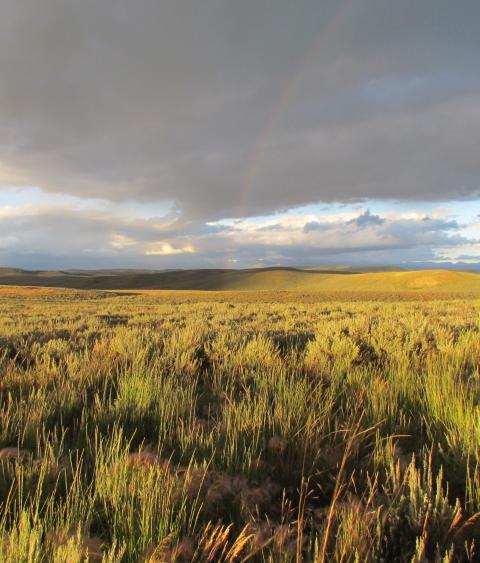
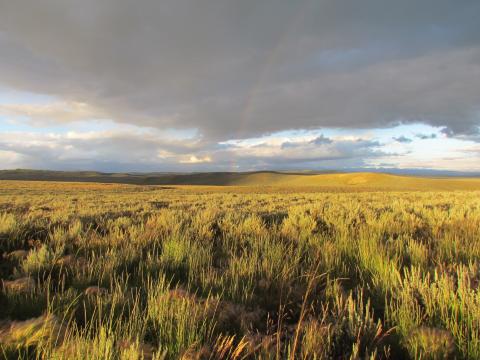
On a bright fall afternoon on Interstate 80, east of Wells, Nevada, I watched a mule deer buck try to cross. Summer range lay behind him and winter range ahead, and between them ran four lanes of concrete and a river of cars, trucks, and trailers. The country on both sides was steeply cut for the interstate, which bisects the sagebrush that most people cross at eighty and call empty.
At what appeared to be his first opening in traffic, he came off the shoulder at a dead run and found himself in the two westbound live lanes. A pickup swerved. A semi leaned on its horn and did not slow, because a semi cannot. He cut between them, stumbled, caught himself, and hit the center divider, up and over, into the far eastbound lanes and the next wall of traffic. Horns. Brakes. He crossed on sheer luck. He cleared the last right-of-way fence, and in front of him stood a near-vertical face of rock.
He tried it anyway. Scrabbled up a few feet and slid back down. After a second failed attempt he realized there was no way up. So he turned around and did all of it again in reverse, the fence, every lane, cars, trucks, the divider, the horns, back to the north shoulder he had started from. Bug-eyed. Sides heaving. Then he stopped.
He tried it anyway. Scrabbled up a few feet and slid back down. After a second failed attempt he realized there was no way up. So he turned around and did all of it again in reverse, the fence, every lane, cars, trucks, the divider, the horns, back to the north shoulder he had started from. Bug-eyed. Sides heaving. Then he stopped.
The Equipment We Were Issued
I have carried that buck for years, and I have come to understand why he stayed with me and why he will not stay with you. We are built to lean toward the near miss and to feel the loss, and we are built to feel almost nothing about the thing that quietly works. A loss lands on us about twice as hard as a gain of the same size. The ancestor who missed a threat was killed by it and left no descendants; the ancestor who missed an opportunity was merely disappointed and lived to leave many. We are the descendants of the fearful, and we feel as they did. The one we can name and picture moves us; a statistic does not, and our compassion does not scale with the number of the suffering, it fades as that number climbs. Two victims move us measurably less than one. The line usually handed to Stalin, that one death is a tragedy and a million a statistic, is not cynicism. It is a description of the equipment we were issued.
Let me show you the other kind of image and watch what it does to you that the buck did not. Years ago, in a wide valley in remote northeastern Nevada, straight dirt roads and flat ground and little vegetation obstructing my view, I saw two pale shapes far ahead in the direction I was driving. Animals, as the distance closed. Pronghorn, closer still. Two fawns, newly born, and it struck me as wrong that their mother was nowhere near them, until I drove past and observed her in the borrow ditch, freshly dead, hit by a vehicle that had come through earlier in the day.
Let me show you the other kind of image and watch what it does to you that the buck did not. Years ago, in a wide valley in remote northeastern Nevada, straight dirt roads and flat ground and little vegetation obstructing my view, I saw two pale shapes far ahead in the direction I was driving. Animals, as the distance closed. Pronghorn, closer still. Two fawns, newly born, and it struck me as wrong that their mother was nowhere near them, until I drove past and observed her in the borrow ditch, freshly dead, hit by a vehicle that had come through earlier in the day.
You felt that more than you felt the buck, and more completely, and the only difference is that this time something died where you could see it. That is not a moral failing on your part. It is the equipment doing exactly what it was built to do.
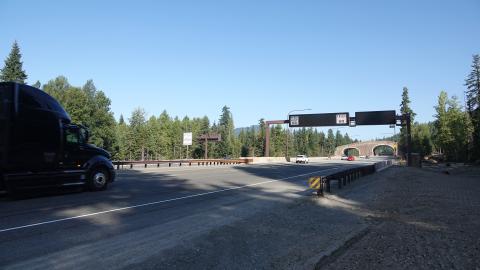
Now I will ask you to feel something, and you will not be able to. Feel every crossing that buck made in the years before and after, the ordinary ones, when he stepped onto the shoulder, found the road empty, and walked across into the sage without a story. Feel the deer that used the wildlife overpass we later built and never became footage. Feel the thousands of acres of winter range that greenstripping protected, compared to the acres that would have gone up in flames without it. You cannot. There is nothing there to feel. Grief attaches to a stock, to a thing that existed and is gone, and a stock can be photographed. A fire scar, a carcass, the last of a kind. Less loss is not a stock. It is a flow, a rate of loss slowed, and worse than that, a counterfactual flow, the distance between the world we got and a worse one that never arrived to be measured. That is not a positive integer. It is the negative of a negative. "I spared you a grief you therefore never felt" collects no gratitude, because the grief never came to the door. We count the acres a fire takes without a second thought. We cannot count the acres it never reached, because you cannot measure an event that did not happen. That impossibility, not mere difficulty, is conservation's burden.
The Company We Keep
Grief attaches to a stock, to a thing that existed and is gone, and a stock can be photographed. A fire scar, a carcass, the last of a kind. Less loss is not a stock. It is a flow, a rate of loss slowed, and worse than that, a counterfactual flow, the distance between the world we got and a worse one that never arrived to be measured. That is not a positive integer. It is the negative of a negative. "I spared you a grief you therefore never felt" collects no gratitude, because the grief never came to the door. We count the acres a fire takes without a second thought. We cannot count the acres it never reached, because you cannot measure an event that did not happen. That impossibility, not mere difficulty, is conservation's burden.
And it runs darker than thanklessness. The preventer is not merely unthanked, the preventer is suspected. A catastrophe that never arrives looks, in hindsight, like a catastrophe that was never real, and the person who spent the money to prevent it looks like someone who cried wolf. Prevention succeeds its way into its own discrediting.
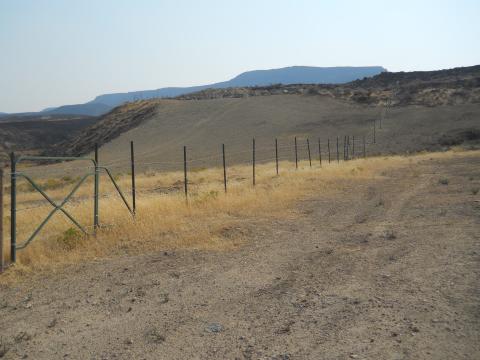
I have knelt beside a mule deer buck that burned to death, charred on blackened ground, and it is the most fundable image I own. But he did not die because we held fire out of that country too long. He died because an annual grass from another continent rewrote the country's relationship to fire. Cheatgrass, cured to tinder by July, a fire cycle that once ran in multiple decades and in places far longer, collapsed now to a few years, and a sagebrush that does not come back on that schedule. The work that would have spared him was the least photographable work there is: keeping intact country free of the invasion, defending the cores that still hold. We fund the war on the fire, the smoke and the retardant and the black scar, because the scar is visible. We will not fund the war on the grass. So we will fight this fire forever.
Our Own Wiring
Here I have to stop pointing at other people's wiring and admit our own, because conservation does not only suffer this problem. It runs on it. The systems we all work inside, the appropriations and commissions and boards and legislatures, demand a countable deliverable to set beside a dollar, because that arithmetic works beautifully for nearly everything else a society buys. We did not invent that demand. But we complied with it, and then we went further. We built our whole emotional case on rescue, because rescue was the one thing that reliably moved money and attention. The burning forest. The oiled bird. The last two of a kind. I have done it myself. I contributed to a film of that buck on the interstate, terrified in the traffic, because I know as well as anyone that eleven seconds of a frightened animal will move a viewer in a way that a map of a severed migration never will. I reached for the spectacle because the spectacle works. And every time we reach for it, we teach our own public that conservation is an emergency room and nothing else, which quietly makes the unphotographable majority of the work unfundable by the very people we trained.
And do not let us blame the machinery alone. Philanthropy is free. A foundation answers to no appropriation and no ballot; it can fund whatever it believes in. And it too, overwhelmingly, buys acres and species, the countable stock, the thing with a name to put on it, and will not fund principle, or policy, or governance, the unglamorous articulation of why any of it holds together. You can name a preserve. No one names a wing after the legal framework that made every preserve possible. When the constrained and the unconstrained arrive at the same choice, you have your proof. It was never only the system. It is the mind, and we share it.
Do the unphotographable work anyway, and do not do it for how it makes you feel... Do it instead for the worth of the thing, which holds whether or not holding it ever feels like anything.
So what is the answer. I do not have a better story for you, and I have come to distrust anyone who tells me the fix is to tell the story better. You cannot narrate your way out of your own wiring. The people who prevent things will not be thanked, will sometimes be suspected, and will watch louder and lesser and more photogenic causes take the funding and the credit, and there is no version of getting the message right that changes that.
Which leaves one discipline, and it is a hard one. Do the unphotographable work anyway, and do not do it for how it makes you feel. The quiet sense of having done right is real, but it is a thin and intermittent wage, and on the days the work is only grinding and losing it does not come at all. If that feeling is your reason, those are the days you quit. Do it instead for the worth of the thing, which holds whether or not holding it ever feels like anything.
That buck was crossing to reach the sagebrush. I called it empty in the first line of this, the flat gray country you cross at speed and forget, and it is the largest, least photographable, least fundable landscape in the West, and it is dying by a mechanism no camera can hold. The best of it, the intact core that is worth everything, looks like nothing has happened there. Because nothing has. That is the whole point of it, and the whole problem with it. It will be held, if it is held at all, by people no one will thank, keeping a country that photographs as nothing and always will.
Nothing to see here.