Outdoor News Bulletin
USGS Scientists to Lead Decision Science Session at North American Conference
USGS scientists from the Cooperative Fish and Wildlife Research Unit (CRU) program are leading a special session at the 91st North American Wildlife and Natural Resources Conference in Columbus, Ohio, on April 2, 2026. The session focuses on how decision science may be applied to common natural resource management problems faced by state fish and wildlife agencies around the country.
Multiple CRUs Leading the Session Together
Drs. Brian Folt (Nevada Unit), Sarah Converse (Washington Unit), and Conor McGowan (Florida Unit) are co-leading the session. CRU scientists have not been typical attendees at the conference, but they are keen to participate this year.
To describe the session, Folt said: “Natural resource agencies and managers have super tough jobs. They have to make difficult decisions about complex problems, with big challenges – legal constraints, competing objectives, many options, passionate stakeholders, and great uncertainty. I’m excited to attend the North American and explore how agency staff can work with CRU scientists to help break through these barriers and work toward robust, durable decisions on their biggest management problems.”
Decision Science
Dr. Converse views decision analysis capacity as a growing resource and opportunity for agencies. “The decision analysis capacity of the CRU program has exploded, and the symposium at the North American Conference is a great opportunity to highlight this. I started my career with USGS 19 years ago, and back then, I pretty much knew everyone in the Department of Interior who was working in decision analysis. Today, I can't even keep track of every person in CRU who is working in this space. It is incredibly exciting to see the many ways that this capacity allows us to deliver more actionable science to our cooperators.”
After an overview by Converse, a series of presentations will describe situations where decision science was used to make headway on a big, expensive, or controversial natural resource problems. Co-delivered by both agency staff and CRU scientists, the presentations will demonstrate examples of effective state-federal relationships, where the states needs were met by working with CRU scientists using decision science and co-production approaches.
Bighorn Sheep Pneumonia, Wolf and Elk Management
One presentation will highlight how structured decision making (SDM) has helped build an enduring partnership between Montana Fish, Wildlife & Parks (FWP) and the Montana Cooperative Wildlife Research Unit.
Justin Gude, Research Administrator for Montana FWP, said: “The application of decision science to real world issues in Montana has provided a vehicle to bridge the research-management divide and provide science directly relevant to decisions that agency staff inform and elected and appointed officials make. It has helped to institutionalize university-agency collaboration – not only because of the technical support, but also due to the establishment of trustful relationships and productive, helpful partnerships.”
“Giving participants practical problem-solving tools and helping them recognize when decision science can help with their real-world challenges – I think that will really resonate and improve how agencies approach conservation decisions.” - Jen Newmark, Western Conservation Coordinator, WMI
Dr. Sarah Sells (Montana Unit) and Gude will present a proactive bighorn sheep pneumonia planning effort as an illustrative example, then situate it within broader applications including wolf and elk management and processes involving both internal agency teams and externally selected stakeholder groups.
Indigo Snake Conservation
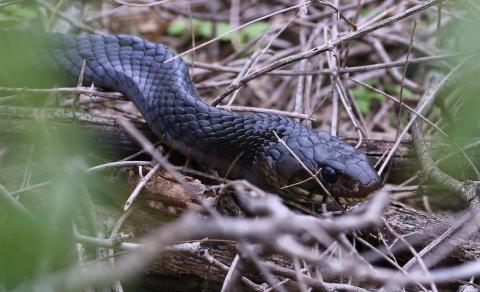
Another talk will explore how a structured decision making (SDM) workshop helped recovery planning for federally endangered species. In particular, the Orianne Society for Indigo Snake Conservation has been working closely with federal and state agencies to overcome challenges during reintroduction programs for the Threatened eastern indigo snake.
Dr. Houston Chandler, Director of Science at the Orianne Society, said: “The SDM workshop we had last year was one of the more effective partnership meetings that I have ever been a part of, and we were at a point in the project where we needed that in-depth, guided discussion.” That workshop included a diverse group of project partners, including state and federal agency staff, and was led by Conor McGowan (Florida Unit).
Modernizing the Statewide Fish Hatchery System in New York
A third case-study presentation will describe a decision-support framework for modernizing the statewide fish hatchery system in New York – co-presented by Michael Schiavone (New York Department of Environmental Conservation) and Dr. Angela Fuller (New York Unit).
The session will then end with a ‘Decision Science Connection Conversation’ – an interactive breakout session where presenters work with audience members to learn about their biggest problems, identify common patterns, and connect participants with resources.
The North American conference is organized and hosted by the Wildlife Management Institute (WMI), and WMI president Tony Wasley noted: “Decision science has existed for decades and has helped solve problems across numerous fields of study, including fish, wildlife, and natural resource management. However, due to a lack of staff or program familiarity on decision science and opportunities it provides, these tools remain significantly underused in the conservation arena.”
Jen Newmark, WMI’s Western Conservation Coordinator, added: “Giving participants practical problem-solving tools and helping them recognize when decision science can help with their real-world challenges – I think that will really resonate and improve how agencies approach conservation decisions.”
The ONB features articles from Cooperative Fish and Wildlife Research Units across the country. Working with key cooperators, including the Wildlife Management Institute, Units are leading exciting, new fish and wildlife research projects that we believe our readers will appreciate reading about. This article was written by Brian Folt, bfolt@usgs.gov, USGS Research Ecologist and Assistant Unit Leader at the Nevada Cooperative Fish and Wildlife Research Unit, and edited by Dawn Childs, dchilds@usgs.gov, USGS Information Specialist.