Outdoor News Bulletin
Beyond the Balance Sheet
I was recently part of a conversation about the importance of conserving wetlands and the waterfowl that depend on them. The arguments presented were familiar and well-crafted. The Federal Duck Stamp program has raised over $1.3 billion and conserved more than 6 million acres of habitat since 1934. Waterfowl hunting alone generates roughly $4 billion in economic activity nationwide and supports nearly 57,000 jobs. Wetlands themselves provide billions of dollars in flood protection, water purification, and carbon storage. In fact, the Global Wetland Outlook published last year estimated that the world’s vanishing wetlands put $39 trillion in ecosystem service benefits at risk. The case was persuasive. It was built on solid numbers, and I found myself nodding along, because these numbers are real and they matter. But as the conversation continued, I noticed that in this particular meeting, every single argument being made for wetlands and waterfowl was an economic one.

The entire justification for conserving these systems had been reduced to their capacity to generate revenue, support jobs, and deliver quantifiable services. Nobody in that room talked about what it feels like to sit in a blind on a November morning and watch a flock of pintails bank into the decoys against a grey sky. Nobody mentioned the particular magic of a prairie pothole at dawn, alive with the calls of a dozen species, or the way a marsh in early spring can make you feel simultaneously insignificant and deeply connected to something ancient. The wetlands had been defended, but only as an economic asset. Part of the reason I enjoy writing this President’s Message each month is that it gives me the opportunity to think through things like this, to poke at an idea until I better understand my own personal mental dilemmas and debates beneath it.
What’s beneath this one, I think, is a question that the conservation community needs to wrestle with more deliberately: How do we highlight and elevate the intrinsic value of wildlife, in an increasingly monetized world? And more to the point, what happens if we don’t?
The Numbers Are Real, and They Matter
Let me say clearly at the outset that I am not anti-economics when it comes to conservation. Anyone who has spent time in the policy arena knows that numbers talk. The National Fish and Wildlife Foundation’s 2025 “Conservation Economy in America” report documented that $55.3 billion in direct conservation spending generated $115.8 billion in total economic activity, supported more than 575,000 jobs, and returned $16.3 billion in tax revenue. Those numbers deserve a place in every appropriations conversation and every meeting with a skeptical legislator. We need them and should use them.
But here’s where the rattling in my head gets louder. When economic arguments become the only language we speak, and the only way we justify the existence and protection of wild things, I think we begin to lose something foundational. Something that is actually at the core of why most of us got into this work in the first place.
The Danger of a Single Language
Aldo Leopold saw this danger with remarkable clarity nearly a century ago. He wrote, “It is inconceivable to me that an ethical relation to land can exist without love, respect, and admiration for the land, and a high regard for its value. By value, I of course mean something far broader than mere economic value; I mean value in the philosophical sense.”
When we reduce wildlife to a line item on a spreadsheet, we sever the very connections that make people want to conserve it in the first place.
Leopold was not naïve about economics. He was, after all, the father of wildlife management, a discipline grounded in applied science and pragmatic resource use. But he understood that economics alone would never be sufficient. He was urging us, even then, to be bilingual, to speak the language of budgets and the language of belonging.
I think about this in the context of my own journey. I didn’t become a wildlife professional because someone showed me a cost-benefit analysis. I became one because of time spent in wild places with people I cared about, watching animals do what animals do, and feeling something that I couldn’t articulate as a young person but that I now recognize as connection. That connection ultimately became respect, and that respect motivated a career of stewardship and protection. It’s the same progression I’ve written about before in this space: connect, respect, protect.
What Gets Lost
The trouble with an exclusively monetized framework isn’t just philosophical. It has practical consequences. When the justification for conserving a species or a habitat rests entirely on its economic value, species and places that don’t generate measurable returns become expendable. The freshwater mussel doesn’t anchor a recreation economy. The dusky gopher frog doesn’t draw tourist crowds. The sagebrush steppe doesn’t photograph like Yellowstone’s Grand Prismatic Spring. Under a purely economic calculus, these become second-tier priorities, or no priority at all.
Leopold warned against exactly this thinking when he wrote, “The last word in ignorance is the man who says of an animal or plant, ‘What good is it?’”
That question, what good is it, presumes that value is determined solely by utility to humans. It’s the same mindset that asks what a wetland is “worth” without ever wondering what it is. It is that very sense of wonder that is the headwater of the conservation ethic. Economic arguments are useful tributaries, but they are not the source. They are often the data-driven justifications we seek to validate our values in our own minds and what we use to try to shape the thoughts and opinions of others. Economic arguments are the tip of the iceberg, with the portion of the iceberg sitting invisibly below the surface of the water being composed mostly of values and their associated emotions.
An Analogy Worth Considering
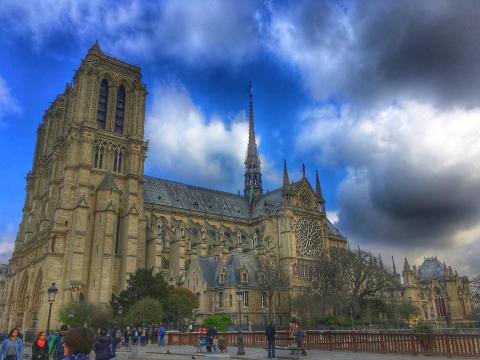
I keep coming back to an analogy that helps me think about this. Consider a great cathedral, say Notre Dame in Paris or La Sagrada Familia in Spain. We can quantify the economic value readily enough: the tourism dollars they generate, the jobs they support, the property values they lift in surrounding neighborhoods. Those are real numbers that matter. But no reasonable person would argue that the sum of those economic calculations captures what these cathedrals mean to the affected cultures, to Western civilization, or to the individuals standing in their splendor for the first time. There is something in the soaring stone and stained glass that cannot be reduced to a dollar figure. The moment we try, we’ve already lost something essential.
Wildlife, I would submit, is the living cathedral of the natural world. A bull elk bugling on a crisp September morning is more than an economic asset. A sandhill crane riding a thermal over the Platte River is more than an ecosystem service. A brook trout holding in the cold current of an Appalachian stream is more than a recreational commodity. These creatures have what Leopold called a “right to continued existence,” not because they earn their keep, but because they are fellow members of the biotic community, woven into the same evolutionary story that produced us.
What I'm Proposing
I’m not suggesting we abandon economic arguments. That would be foolish and counterproductive. WMI has long understood that conservation must engage with the world as it is, not as we wish it were. We work within economic and political systems because that’s where the decisions are made.
What I am suggesting is that we become more intentionally bilingual. We need to continue speaking the language of economics with confidence. But we also need to cultivate, and never be embarrassed to speak, the language of ethics, of aesthetics, of wonder, and of obligation. Leopold modeled this himself. The same man who wrote the textbook on game management also wrote that “a thing is right when it tends to preserve the integrity, stability, and beauty of the biotic community. It is wrong when it tends otherwise.” He understood that science and sentiment, data and devotion, are not opposites. They are partners.
In practical terms, this means that when we testify before legislatures or brief decision-makers, we lead with the economic data, but we don’t stop there. We tell the stories. We remind lawmakers that their constituents care about wildlife not merely because it generates revenue, but because it sometimes feeds humans and often feeds something in the human spirit that no amount of GDP can satisfy.
It means that in our education and outreach, we invest as deliberately in cultivating wonder as we do in teaching biology. It means taking a kid to see a bald eagle’s nest before we explain the Endangered Species Act.
The Striving
Leopold wrote in Round River, “We shall never achieve harmony with land, any more than we shall achieve absolute justice or liberty for people. In these higher aspirations the important thing is not to achieve, but to strive.”
Let’s never mistake the ledger for the landscape.
That striving is the heartbeat of the conservation movement. It’s older than any market mechanism and more enduring than any balance sheet. It’s rooted in the conviction that the natural world matters, not because of what it can do for us, but because of what it is.
So, let’s count the jobs and tally the tax revenue and quantify the ecosystem services. But let’s never mistake the ledger for the landscape. The intrinsic value of wildlife is not a luxury we can afford only when times are good. It is the very foundation upon which all durable conservation is built. And in our increasingly monetized world, I believe that elevating and articulating that intrinsic value may be among the most important things we can do.
I’d welcome your thoughts on this one.