Outdoor News Bulletin
Running Out of Up
Nearly every conference call I have joined lately has opened with weather. Not as small talk but as a report. Flooding in Idaho, and again in Iowa. Thunder in Pennsylvania loud enough to derail an agenda. Snow in Montana well after the season should have closed. Heat dome in the East canceling activities. Everyone has a story now, and the stories keep arriving from every direction at once.
Weather is not climate, and I know the difference. But enough strange weather, from enough places, begins to read like a message about the climate beneath it. Following that thought is what keeps carrying me back to a room in Minnesota.
A few years ago, I sat in a conservation gathering there when the conversation turned, as it always does, to climate. Most of the people in the room had spent their careers in the upper Midwest, and as they worked through what a warming climate would mean for the species they knew best, one phrase kept surfacing: the northward march. As summers grow hotter and the ranges species can tolerate shift, the reasoning went, animals and plants will move north toward cooler ground, following the climate envelope as it slides up the map. Migration would carry them out of harm’s way. The idea was so intuitive to everyone in that room that no one thought to explain it or defend it. It was simply how things would work.
I recognized something true in it. I also could not help comparing it to a picture that looks nothing like the one out their windows, because I come from a different kind of country. And the difference between their picture and mine is not really about animals. It is about how far away the danger looks from where a person happens to stand, and therefore how urgent it feels.
What the Ground Beneath Us Teaches
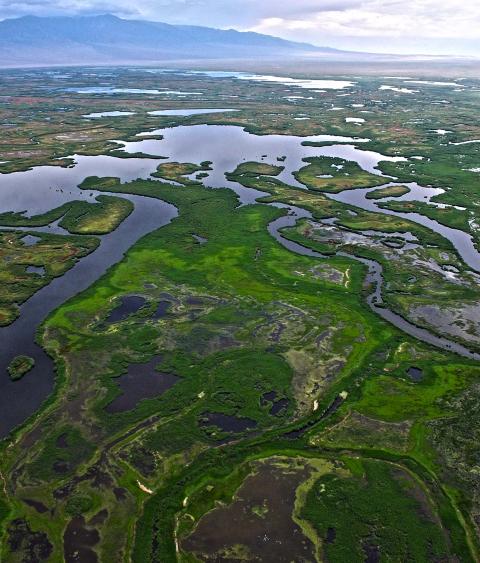
The upper Midwest sits on glacial outwash: broad, low, gently graded country where the land runs on toward the horizon and keeps running. On that ground, the intuition that there is always somewhere cooler to go is easy to understand, because the northern horizon seems to stretch on without end. It is an honest reading of the earth beneath your feet, where the exit really is somewhere over the horizon. You cannot see where the country ends, because from where you stand it does not appear to end at all.
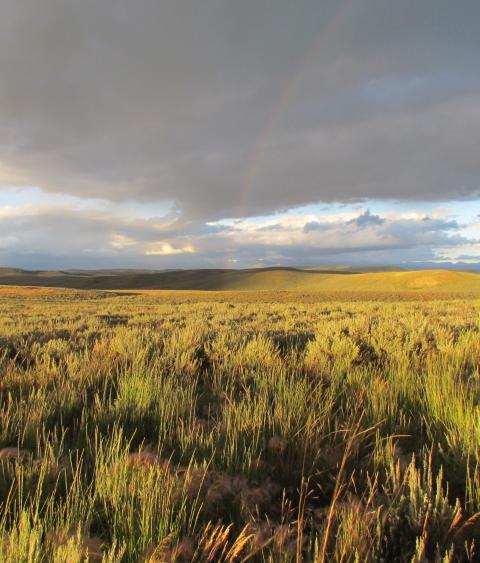
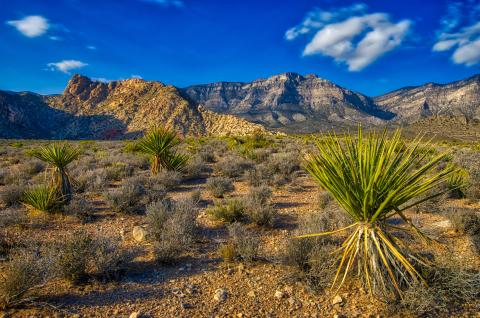
My high desert calibrates me differently. Nevada is bounded by 314 named mountain ranges and the basins that separate them, with 35 peaks rising above 10,000 feet—and when your world is built that way, you learn early that up is a staircase with a top. We can see the summit where the land meets the sky. The perspective is one of elevation, of finite tops and bottoms, bounded by the next range on the horizon.
Movement is one of the oldest and most essential strategies in the natural world, and connectivity is the infrastructure that makes it possible.
We reason, all of us, from the ground we have actually stood on, the same way we reason from the neighborhoods we grew up in, the work we have done, and the winters we have survived. Geography is one of the quiet authors of what we find obvious. Neither the plain nor the peak lies to the people who live on it. Each shows a different part of the same truth and hides the rest.
What a landscape gives us is not only a view but a reflex. It hands us the answer we reach for before we have thought it through, then hides the reaching, so the answer arrives feeling less like a preference than like plain common sense. The person raised on open country reaches for the open exit. The person raised among summits reaches for the limit. Neither is wrong about home. The error is taking the logic that one piece of earth taught us and carrying it onto every other piece of earth, as though it were a law of the world rather than a habit of place. My own mountains can fool me. A country that always shows its ceiling can train a person to trust only the limits they can see, and to discount the ones that lie beyond the horizon, slow and quiet and no less final.
Movement Was Always the Point
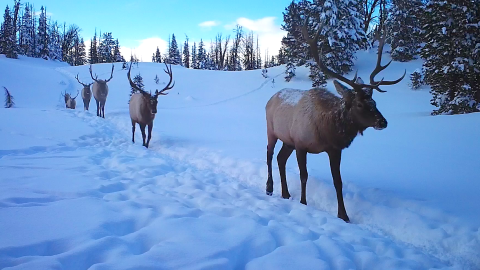
Movement is one of the oldest and most essential strategies in the natural world, and connectivity is the infrastructure that makes it possible. Pronghorn move between summer and winter range because neither one alone will carry them through the year. Birds thread the same migratory corridors their ancestors did. Elk follow the green-up uphill and retreat ahead of the snow. None of this depends on a changing climate. In a climate that never warmed a single degree, connectivity would still be a load-bearing component of ecosystem health and protecting it would still rank among the most important work we do.
But seasonal movement and climate adaptation are not the same problem wearing different clothes. Seasonal movement solves a problem of suitable space. The good habitat is over there this month, so the animal goes there and comes back. The range is fixed, and only the occupant moves within it. Climate poses a different problem. The envelope itself is moving, it is moving in one direction, and it does not come back. Connectivity lets a species track that shifting envelope only for as long as there is suitable ground in the direction it is shifting. The corridor is a lifeline right until it runs into something the climate keeps sliding past: a coast, a soil, or a summit.
In the desert we watch species work down the list of possible adaptations. When daytime heat becomes too much, many go nocturnal, moving their lives into the cooler hours. When that is no longer enough, they climb, because a few thousand feet of elevation can buy the same relief as hundreds of miles of latitude. And then, at some point, they run out of up. The staircase ends. The animals already standing on the top step have nowhere left to go, and the endpoint is not theoretical, or far off, or comfortably out of sight. It is right there, and you can see it.
The Mountain Tells the Truth First
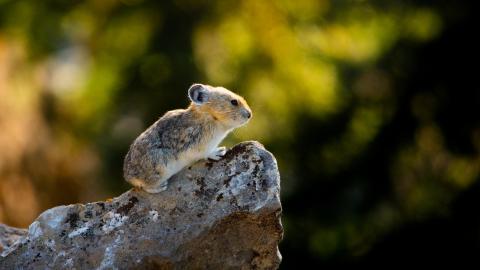
The American pika is the plainest teacher we have. Pikas live on the cool, rocky slopes of high country, and across the Great Basin we have watched them disappear, range by range, from places they occupied within living memory, retreating upslope as the warmth climbs behind them until, on the lower and drier mountains, there is no slope left to retreat to. They are not failing to move. They have moved as far as the mountain allows. The mountain has a top.
Here is what the mountain actually shows us—elevation does not create the only ceiling, it reveals the ceiling that latitude merely hides. The northward march ends too. It ends at the edge of the boreal, at the shore, at a warming front moving faster than seeds and slow generations can follow. The plain has the same terminus the mountain does. It sits farther away and out of sight, and that invisibility is precisely what makes it dangerous, because it lets us believe the movement itself is the rescue. When I described the elevational ceiling to my colleagues in Minnesota, the room changed. Some were surprised, and some were alarmed. A finite, visible limit made the whole thing real in a way the open horizon never had. That reaction was the most useful thing I carried home.
Where the Climbing Stops
If a visible ceiling is what finally makes the stakes real, then our task is not to look away from the places where the climbing stops. It is to look straight at them, and to be honest that connectivity, for all its enduring value, buys time rather than removing the ceiling. Time is worth buying. But time is not a plan.
Connectivity is essential, both for seasonal movement and for climate adaptation. But it assumes there is a place to be connected to, that if an animal moves a little north, or a little higher up the mountain, it can settle into a new and warmer world. Just as a mule deer can return to its winter range only to find it burned the summer before, a species can reach the mountaintop, or the far edge of the plain, and find no ground beyond it. Connectivity cannot be the whole answer.
The work we have been deferring is harder and less familiar. It means identifying and protecting climate refugia – the cool, buffered, groundwater-fed, north-facing places that will hold on longest – and treating them as the priority they are. It means having the uncomfortable conversations about triage, about where our finite effort will and will not make a difference, and about assisted movement for the species that cannot reach safe ground on their own. And it means confronting the forcing itself, because every strategy downstream of a warming climate is a delaying tactic until we slow the warming. None of this replaces connectivity. All of it is the work that connectivity alone was never going to finish.
There is a discipline here that runs past the ecology, and it returns me to those conference calls. The floods and the late snow and the thunder are the climate made visible, the part we cannot miss. But most of what a changing climate is doing is slow, quiet, and offstage, and how much of it we notice depends heavily on where we stand. Each of us reasons from some formative ground, and every formative ground hands us a default while hiding its own edge. Those who live nearest a visible edge tend to feel the urgency soonest. Those whose edge lies far off, out of sight, are the ones most tempted to mistake distance for safety.
So the question worth carrying is not only where the climbing stops for a pika on a Nevada peak. It is what our own geography has trained us to assume, and what it has quietly kept out of view. Those on the open plains might ask whether the exit they are counting on truly has no end. Those of us in the mountains might ask what slow and distant limits we overlook because we have grown so used to reading the ones up close. The strategies we build inherit the blind spots of the places that made us, and a profession that never interrogates those blind spots will keep designing for a world that exists only from where it happens to be standing.
Somewhere on a mountain in Nevada there is a pika on the top step with nowhere higher to climb. We can see its ceiling clearly. Ours is the same, only farther off. Our work is to keep building for the day the climbing stops and the edge of the plain is reached, while we still have elevation and latitude to spend. The harder discipline, for all of us, is to keep asking what the ground beneath our own feet has trained us not to see.