Outdoor News Bulletin
Building a Strong Foundation for Regional Fish and Wildlife Collaboration in the Northeast
For decades, partners in the Northeast have been setting the stage for a transformational approach to conservation – looking past jurisdictional boundaries to identify shared goals for species and natural systems and co-develop science to inform strategic actions on the ground. The Northeast Landscape Wildlife Conservation Committee continues this legacy, connecting state agencies, federal partners, and nongovernmental organizations around priority landscapes and regionwide needs.
A Tradition of Working Across Borders
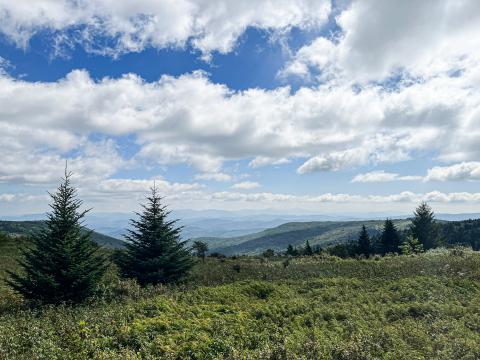
The Northeast’s dense mosaic of towns, cities, and states can make it easy to overlook the globally significant ecological systems spanning the region, like the 2,000-mile Appalachian Mountain range and the six-state Chesapeake Bay watershed. Navigating overlapping boundaries to meet needs for people, fish, and wildlife requires collaboration. For decades, Northeast state fish and wildlife agencies have pooled knowledge and resources through the Northeast Association of Fish & Wildlife Agencies (NEAFWA). By institutionalizing regional collaboration through a suite of committees, shared data systems, and regional initiatives, NEAFWA has become a vehicle for addressing conservation challenges that don’t stop at state lines. Some early examples of regional conservation initiatives include:
- In the 1950s wild turkeys were largely absent from much of the Northeast. When they began naturally expanding their range, the northeastern states worked together to accelerate their restoration through trap and transfer at the landscape scale, successfully implementing a comprehensive strategy to bring this important game bird back to our landscape.
- In 1999 the Northeast Fish and Wildlife Diversity Technical Committee (NEFWDTC), consisting of wildlife diversity managers throughout the Northeast, developed the first list of Regional Species of Greatest Conservation Need (RSGCN). They used a data-driven approach to identify the species of concern that were shared across state boundaries. Since the first RSGCN list, there have been four iterations, each informed by new data. The current (2023) update identifies 806 species across 20 taxonomic groups, as well as key habitats that support the species and key threats that they face.
- Other technical committees within NEAFWA also worked across state lines to coordinate on important topics like Fish Health Management and population monitoring for Black Bears and to develop regional products, including Trapping and Furbearer Management: Perspectives from the Northeast published in 1996 by the Northeast Furbearer Resources Technical Committee, which served as a foundation for a national product in 2001.
The Regional Conservation Needs (RCN) Program: Shared Science for Shared Priorities
In 2007, NEAFWA tried something innovative; state agencies agreed to pool a portion of State Wildlife Grant funds, providing a dedicated funding source to support significant regional conservation needs. This Regional Conservation Needs (RCN) program, administered by the NEFWDTC, has become a cornerstone of collaborative conservation in the Northeast. To date, the program has supported 59 projects, ranging from habitat classification and condition assessments to multistate species monitoring and restoration tools, including a 2023 Northeast Regional Conservation Synthesis. This shared regional framework supported states as they developed their third generation State Wildlife Action Plans (SWAPs) in 2025.
Meet the Landscape Committee
Building off regional collaborative success and propelled by the 2018 AFWA Resolution on Landscape Conservation, the Landscape Committee was founded in 2022 to provide leadership and address barriers to advancing landscape-scale conservation. Representing 13 state wildlife agencies, the District of Columbia, the U.S. Fish and Wildlife Service, U.S. Forest Service, and U.S. Department of Agriculture Natural Resources Conservation Service (NRCS), the Landscape Committee is a hub and a catalyst: synthesizing knowledge and priorities across all committees within NEAFWA and advancing shared goals for conserving priority landscapes in the face of challenges and opportunities.
In this capacity, the Landscape Committee supports efficient and effective collaborative conservation by:
- Fostering strategic partnerships: Provides a forum for partners to align priorities, develop shared objectives, and translate vision to on-the-ground conservation action
- Mobilizing resources: Leverages resources and expertise to secure funding and support for large-landscape conservation
- Reducing costs and barriers: Streamlines project costs and reduces administrative barriers to implementation
- Building capacity: Empowers partners with knowledge, tools, and resources to address conservation challenges that span borders
High Priority Landscapes and Themes
Working with each of the NEAFWA committees, the Landscape Committee identified seven high priority landscapes and themes, with an initial focus on the Atlantic Coast and the Appalachian Corridor.
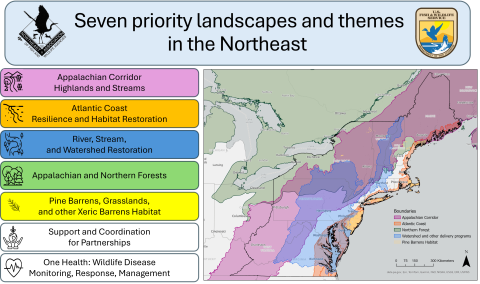
The Landscape Committee is working closely with ongoing partnerships in these landscapes —including the Appalachian People and Places Collaborative, the Atlantic Coast Salt Marsh Collaborative, the Migratory Bird Joint Ventures, Eastern Brook Trout Joint Venture, the Staying Connected Initiative, Northeast Transportation and Wildlife Collaborative, and the Regional Conservation Partnership Network — by engaging in their strategic planning processes and reinforcing priorities for fish, wildlife, and habitats.
To date, the Landscape Committee has leveraged more than $20 million through America’s Ecosystem Restoration Initiative and other sources to advance strategic conservation goals in priority landscapes. One exemplary project in the upper Delaware watershed provides capacity and resources to improve aquatic connectivity for brook trout and other cold-water species. For more information on supported projects, visit the Landscape Committee’s story map.
Place-Based Programs that Scale Regional Action
The region is also home to several place-based landscape investment programs that complement the Regional Conservation Needs program and other funding sources and can be leveraged to advance Landscape Committee priorities.
- Chesapeake WILD funds planning, collaborative capacity, and on-the-ground projects that restore, connect, and make habitats resilient across the six-state Chesapeake Bay watershed. To date, Chesapeake WILD has awarded $26.4 million to 99 projects, which have generated $34.1 million in matching funds for a total investment of more than $60 million in the watershed.
- The Delaware River Basin Restoration Program (DRBRP), drives voluntary, incentive-based conservation across four states, awarding competitive grants for habitat restoration, fish passage, water quality, floodplain reconnection, and public access through the Delaware Watershed Conservation Fund. Since its launch in 2018, the fund has awarded $85.5 million to 270 projects, which have generated $120 million in match for a total investment of $205 million in the watershed.
- The Highlands Conservation Act Grant Program funds land conservation in support of fish and wildlife habitats, forests, water quality, and cultural resources in the four state Mid-Atlantic Highlands Region. Since passage of the Highlands Conservation Act in 2004, $52 million in federal funds, matched by $79 million in non-federal funds, have been awarded to protect more than 19,000 acres of land and water.
Here is a just a sample of coordinated action in the region:
Developed by the Eastern Grouse Working Group to stabilize and restore ruffed grouse through coordinated habitat strategies across states and provinces in the eastern range.
An Atlantic Coast Joint Venture framework to increase high marsh resiliency and nest success for a species that has declined ~87% since 1998; a signature example of multistate coastal bird conservation in the Northeast.
An RCN supported, Nature Conservancy led assessment and toolset that ranks barriers (dams/waterfalls) to aquatic connectivity and served as a model for a nation-wide version.
Supported by RCN and Competitive State Wildlife Grants, this set of status assessments and conservation plans includes standardized monitoring and a vision for proactive conservation for wide-ranging RSGCN including Wood, Blanding’s, Spotted, and Box Turtles.
A partnership effort to create early successional habitat to support northeastern wildlife species.
Leading the Way
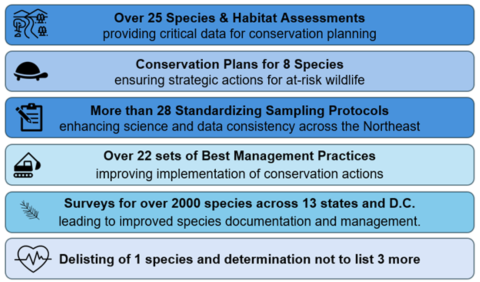
Many of the products developed in the Northeast have been adapted and adopted by other regions, building foundations for similar RSGCN programs in the Midwest and Southeast, for example. The novel Regional Conservation Needs program also served as a model for current landscape conservation efforts and new tools like the Collaborative Conservation Initiative, an emerging vehicle currently being piloted by the U.S. Fish and Wildlife Service’s Office of Conservation Investment to support inter-state collaboration. The Northeast Upland Game Bird Technical Committee’s initial charge to coordinate a ‘multi-state grouse conservation initiative’ expanded outside of the NEAFWA region and became the Eastern Grouse Working Group, which developed a Ruffed Grouse Conservation Plan for the entire eastern U.S.
Nationally, multistate landscape scale approaches are on the rise, and recent Outdoor News Bulletin features from the Midwest Landscape Initiative and the Western Association of Fish & Wildlife Agencies (WAFWA) spotlight how cross-jurisdictional partnerships deliver science and action at meaningful scales in other parts of the country. The Landscape Committee recently met with its neighboring regional partnerships to discuss how to continue to learn from each other and collaborate across boundaries to connect landscape conservation initiatives nationwide.
"Nature doesn’t recognize state boundaries, which is why effective conservation often requires work at the landscape scale. By bridging the gap between state and federal land management agencies, conservation organizations and private landowners, we aren't just restoring habitat—we’re investing in local economies and communities. Managing at a landscape scale today ensures that the next generation inherits a thriving and fully functional environment."
- Paul Johansen, Chief of the West Virginia Division of Natural Resources Wildlife Resources section, AFWA President, and Co-Chair Northeast Landscape Wildlife Conservation Committee
When asked by U.S. Fish and Wildlife Service Director Brian Nesvik what the agency should prioritize, collaborative landscape conservation emerged as one of four themes that state and tribal fish and wildlife agencies identified. In response, the agency is developing a State Fish and Wildlife Agency Action Plan to implement the recommendations, reinvigorating and elevating the important collaborative partnership with state fish and wildlife agencies.
Building on the synergy between these efforts, the release of third generation SWAPs, and the establishment of other regional priorities, the Landscape Committee is poised to amplify its role as a convener, continuing to support collaborative multistate conservation work into the future.