Outdoor News Bulletin
From Incomprehensible to Intuitive
In graduate school, a professor of mine posed a question one afternoon that has stuck with me ever since. He asked, if Charles Darwin had not described the process of natural selection, would someone else have figured it out? The room split. I answered yes. Natural selection seemed so intuitive to me, so cleanly mechanical, so obviously how the system had to work, that I could not imagine the idea remaining undiscovered for long. Plenty of my classmates disagreed. They argued that the concept was so far outside the human-centered view of time that the leap was much harder than I was crediting. Without Darwin, or without someone else who happened to have his particular cast of mind, the leap might have waited another century.
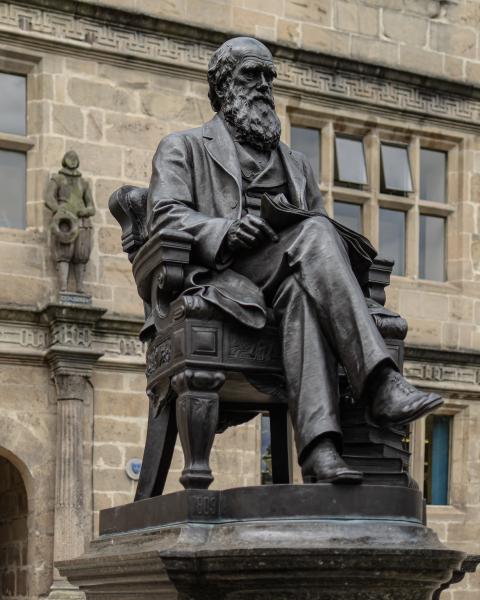
I have thought about that question many times since. I still answer yes, but with more humility about why my answer comes easily. The reason natural selection feels intuitive to me is not because I am especially perceptive. It is because I grew up inside a frame in which it had already been described. Generations of students before me had absorbed the idea until it became the background hum of biology. My professors taught it as a starting point, not a destination. By the time it reached me, the frame had already shifted. The thing my classmates were right about, and I was missing, is that the difficulty of an idea is not a property of the idea itself—it is a property of the frame the listener brings to it.
Before Darwin, the audience that needed to receive natural selection was operating inside a human-centered view of time. Lifespans. Generations. Maybe a few thousand years of recorded history. That is the time horizon the human mind reaches for unaided. To absorb natural selection, you have to stretch your mental clock across geological epochs. You have to hold deep time. You have to accept that processes too slow to observe in a human life can produce, over millions of years, every living form around you. That is not a small cognitive ask. For an audience whose intuitions were calibrated to human time, the idea was not just unconvincing. It was incomprehensible.
Ideas That Are Not Hard to Believe but Hard to Hold
There is a category of ideas that operate this way. They are not particularly controversial once you can hold them in your head. The difficulty is the holding. The idea requires the listener to expand or rearrange the mental frame they brought to the conversation, and until that expansion happens, the idea does not register as wrong so much as it registers as not quite parsing. Cognitive scientists call this “conceptual change,” and the literature on it goes back at least to Thomas Kuhn. The point is that some ideas cannot be absorbed by adding new information to an existing frame. They require the frame itself to shift.
Once the frame shifts, the new idea becomes obvious, often to the point that people cannot reconstruct why it ever seemed strange. Germ theory is the canonical example. Before it, the idea that doctors might be spreading disease by going from cadaver to delivery room without washing their hands was not just unproven. It was unthinkable. Within fifty years of the shift, the same idea was so obvious that no one could imagine a world in which it had ever been controversial for physicians to wash their hands. Plate tectonics ran the same arc. Heliocentrism ran the same arc. Each began as incomprehensible and ended as intuitive, with no change in the underlying claim. Only the frame moved.
A Conceptual Change Now Reaching Maturity
I have come to believe that wildlife conservation has its own version of this pattern currently underway, and that it is now late enough in the process that we can name it. The concept is habitat connectivity at landscape scale. Corridors, crossings, the recognition that wildlife populations cannot be sustained as isolated units, the understanding that the spaces between protected areas matter as much as the protected areas themselves. These ideas are now becoming intuitive across the field. They were not intuitive thirty years ago. Or even twenty. The arc from incomprehensible to intuitive has happened in front of us, and many of us have lived through enough of it to remember when the idea was treated as fringe.
The cognitive obstacle was the same one Darwin's audience faced, just applied to space rather than time. The human mind naturally thinks about land at the scale of a human home range. The parcel we can walk in a day. The country we can see from a ridgeline. The acreage on a deed. That is the spatial frame human beings have always lived inside, and it is the frame we instinctively bring to questions about wildlife. We think in parcels because we have always lived on parcels.
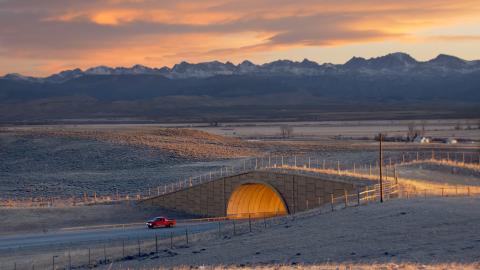
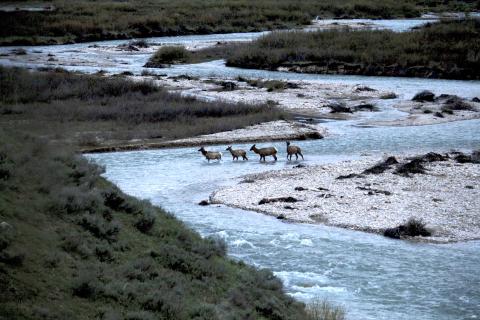
The connectivity frame asks us to think at the scale wildlife actually use, which is often dozens or hundreds or thousands of times larger than what a human home range looks like. A mule deer moving between summer and winter range may cross over sixty miles of country and a dozen jurisdictions in the process. A pronghorn population in Wyoming may depend on the same fence crossing every year for generations. A wolverine may patrol a home range larger than a small state. None of this fits inside the parcel frame. To absorb it, you have to expand your spatial imagination past the scale at which human beings naturally operate, which is exactly what Darwin's audience had to do with time.
The energy expenditure piece of the puzzle takes the cognitive shift further still. Once you grasp that wildlife move at landscape scale, you have to grasp that those movements come with metabolic costs that are themselves shaped by the connectivity of the route. A mule deer that encounters fewer fences, fewer roads, fewer development pinch points, fewer subdivisions, arrives on winter range with more fat reserves and a better chance of seeing spring. Connectivity is not just about whether an animal can physically get from point A to point B. It is about how much of itself the animal has to spend to make the trip. That is a subtle second-order insight that, like natural selection at the molecular level, only comes into focus once the first-order concept is in place.
Evidence That the Frame Has Shifted
Here is what tells me the conceptual change has matured. In February of 2018, the Department of the Interior issued Secretarial Order 3362, titled "Improving Habitat Quality in Western Big-Game Winter Range and Migration Corridors." The order directed federal land managers to work with western states to identify and conserve big game migration corridors and winter range. It was, at the time, a striking departure from the parcel-based conservation logic that had dominated federal land management for a century. It treated corridors as conservation priorities in their own right, not as connective tissue between more important places.
What is most striking about SO 3362 is not the order itself but its trajectory since. It was issued by a Republican administration. It was continued by a Democratic administration. It is being implemented now across western states regardless of which party holds the governor's office. It has produced state-level corridor delineations, federal funding through the Bipartisan Infrastructure Law for wildlife crossings, tribal co-management partnerships, and private landowner easements that would have been politically impossible in the parcel era. None of this is small. All of it is evidence that the frame has shifted at a level deeper than the policy of any single administration.
An idea has fully arrived when its application no longer feels partisan. Hunters in red states want corridor protections because they understand what corridors do for elk and mule deer populations. Conservation biologists in blue universities want corridor protections because they understand what connectivity does for genetic diversity and population viability. The Rocky Mountain Elk Foundation and the Nature Conservancy and tribal nations and the Department of Transportation and the Bureau of Land Management and ranchers and energy developers and ski resort operators have all, in their various ways, accepted the connectivity premise. They argue about the specifics. They no longer argue about the frame. That is what conceptual change looks like in its mature phase. The argument has moved on to second-order questions, which only happens once the first-order question is settled.
The Pattern Worth Watching
Two thoughts on what to do with this observation. The first is to take a moment to appreciate that framework shifts of this scale are rare, and we have lived through a real one. Most of us go through our careers in professions whose foundational frames do not visibly move. We have been lucky to be working in conservation during a period when one of the central frames of the field has shifted out from under us, and to have been alive long enough to remember the before-state and witness the after-state. And to see the real-world impact that shift has had on successful conservation. That is not a common gift, and it’s worth noticing.
The second is to ask which ideas in our field are currently in the early or middle phase of the same arc. Which concepts are now considered fringe or impractical or politically impossible that will, in twenty or thirty years, be considered obvious? The honest answer is that we cannot fully know in advance, because the frame shift is what reveals the obviousness. But we can make educated guesses. Counterfactual conservation success (asking the question of what would have happened without this conservation action) is probably one. The public trust doctrine, properly understood as the operating principle rather than a legal technicality, is probably another. A funding model for non-game and at-risk species that does not rest entirely on hunter and angler dollars, which has stalled politically for decades, may be in the late incubation phase now.
If the connectivity arc tells us anything, it tells us that the gap between fringe and obvious can close faster than it looks like it can. Twenty years ago, suggesting that the federal government would spend hundreds of millions of dollars on wildlife crossings would have struck most people as wishful thinking. Today it is a dedicated $350 million federal program with bipartisan reauthorization moving through both chambers. The frame moves slowly until it moves quickly, and then it never moves back.
I think about my graduate school professor's question more often than I used to. If Darwin had not described natural selection, would someone else have figured it out? I still think yes. But I now understand that the question is less about whether the discovery would have been made and more about how long the rest of us would have had to wait for the frame to shift.
Our work in conservation, in the end, may be less about discovering new ideas and more about helping the frames click into place that will make existing ideas obvious to the next generation. The discovery is sometimes already there. The job is to help everyone else see it.