Outdoor News Bulletin
Scot Williamson Retires from WMI
Wildlife Management Institute Vice President Scot Williamson retired April 3, 2026, after 32 years of service to the organization. Prior to joining WMI as the Northeast field representative in 1994, Scot was deer project leader for the New Hampshire Fish and Game Department and big game program director for Texas Parks and Wildlife. As field representative, Scot quickly saw the need for projects that spanned state and international boundaries and helped state and federal initiatives with fundraising, contract management, project oversight, and communications.

Building Partnerships
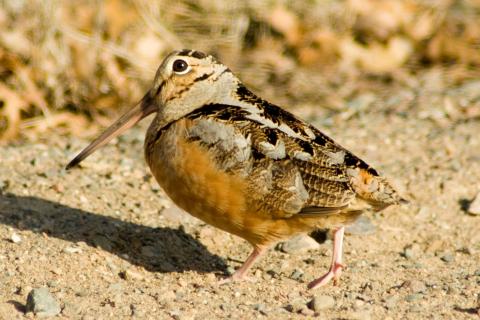
Scot was co-author of the American Woodcock Conservation Initiative, and following publication coordinated the creation of a multi-state, multi-agency partnership to implement the Plan. The Initiative was recognized with the U.S. Forest Service and Natural Resources Conservation Service’s Two Chiefs Award in 2012 and the Cooperative Conservation Award from Department of the Interior Secretary Dirk Kempthorne. Reflecting the multiple species that are similar to American Woodcock by requiring young forest/early successional habitat, Scot helped partners to expand the initiative to focus on New England Cottontail and migratory birds across the Northeast.
Steve Weber, a WMI contractor supporting the New England Cottontail (NEC) Technical Committee, noted, “Scot generally works quietly behind the scenes and played a critical leadership role in establishing the governance structure that has allowed the group to work effectively together. Scot convened the first meeting of the NEC Executive Committee in February of 2011, which was attended by state fish and wildlife agency directors helping to solidify the commitment of the states to work together. He helped write the bylaws and supported the development of the Conservation Strategy in cooperation with the U.S. Fish and Wildlife Service.”
As state and federal agencies embraced landscape level conservation, Scot again advanced the mission of WMI by creating administrative services for removal of barriers to conservation. One popular service is the Partner-Based Employee (PBE) Program that allows WMI to employ a nationwide, diverse range of conservation specialists, including biologists, fisheries technicians, grassland managers, and foresters.
“Scot Williamson has been a great mentor to me personally during my time at WMI,” concludes WMI president Tony Wasley. “He is a true innovator, always seeking creative ways to help partners and the organization. He is leaving an indelible and positive mark on WMI for years to come. I am happy he will be able to pursue his interests and passions beyond the conservation work that has been so important to him, but his departure leaves a chasm of knowledge, experience, and creative partner-based solutions that will be difficult to fill.”
WMI pledges to continue the collaborations triggered by Scot’s leadership. The PBE program is now administered by WMI CFO Meghan Gilbart (mgilbart@wildlifemgt.org) and Wasley is discussing with partners how best to structure the WMI Northeast Field Representative position.
Reflections on Scot’s Time at WMI
Former WMI president Steve Williams who retired in 2023 first met Scot at Penn State around 1976. “In our 50-year friendship we have shared similar professional jobs and many good memories. Early on, as deer biologists in New England, we learned from the old timers but evolved into semi-modern professionals. The highlight for me was the 18 years when Scot and I provided leadership for WMI. Scot’s ability to develop partnerships and his innovative thinking played a critical role in maintaining and then increasing WMI’s relevance to the wildlife profession. Ever the professional, Scot’s contributions will be long-lived, not just to WMI, but to the conservation profession.”
Retired WMI officer and Williamson hunting partner, Dick McCabe observed, “Scot is known to some close associates as ‘Dances With Sharptails’ for his odd behavior of loping over western grasslands, minus firearm, to run down prairie grouse. Scot’s feeble explanation is that, in such manner, he pursues only wounded, flight-impaired birds. However, the same aforementioned associates insist he learned and practices the technique hunting woodcock in his backyard, the Northeast Kingdom. None of that weird behavior would be necessary, say the associates, if Scot were a better wing shot.”
In pursuit of any conservation agenda, said McCabe, Scot was enthusiastic, engaged and professional. “Although he tends to be reserved, Scot is very personable. I particularly appreciated his exceptional work ethic, but above all, I valued his friendship during our years together at the Institute. I still do.”