Outdoor News Bulletin
Tracking Waterfowl Movements and Avian Influenza
A collaborative project led by USGS researchers at the Georgia Cooperative Fish and Wildlife Research Unit, University of Georgia, and National Aeronautics and Space Administration (NASA) explores when and where waterfowl (ducks, geese, and swans) move most. Wild waterfowl are among the natural hosts of low-pathogenic avian influenza viruses, which do not cause illness in poultry or humans, but they also play a role in the spread of highly pathogenic avian influenza. Understanding why, where, and when they move can help predict viral spread.
Waterfowl Movements and Avian Influenza Outbreaks
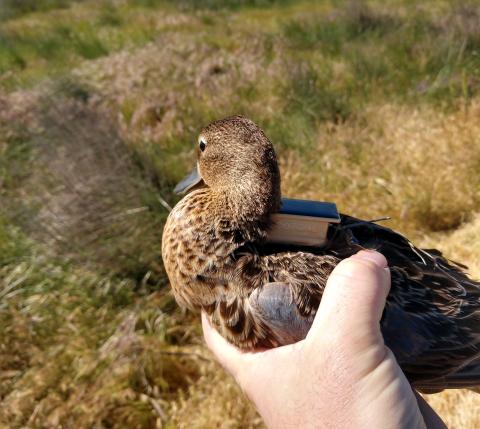
Waterfowl are important because they are widespread and because they are hosts of avian influenza viruses. Livestock production is the primary contributor to outbreaks of highly pathogenic avian influenza, but waterfowl movements also play a role in the spread of these economically damaging viruses. By understanding when, where, and why waterfowl move, we can come closer to predicting and preventing outbreaks.
To measure the links between waterfowl movements and avian influenza outbreaks, the researchers overlaid models of waterfowl movements with locations of avian influenza detections in wild birds during the ongoing outbreak. They found that avian influenza detections (outbreaks) tended to be farther apart where waterfowl movements were predicted to be longest.
Gathering Global Data
Studies of animal movements usually focus on a single population or region and provide detailed information about when and where individuals are moving. This information can inform population and habitat management at local scales. Putting these studies together can provide information about why animals move more generally – are these populations more similar than they are different? Waterfowl are widespread: mallards, for example, are native to tropical, temperate, and Arctic regions across North America, Eurasia, and Africa. Many waterfowl species are also adaptable, which is why they are common in both urban ponds and in pristine natural wetlands. These traits make comparing drivers of waterfowl movements across the globe both interesting and important.
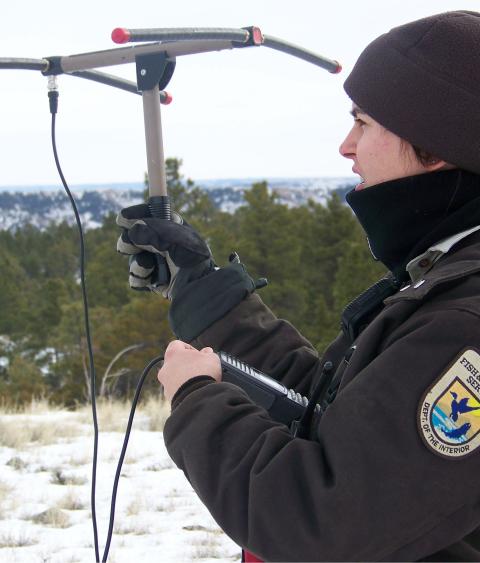
To study similarities and differences in waterfowl movements and the places these species live, scientists from USGS and NASA gathered as much tracking data on waterfowl across the globe as they could. Starting from an online repository of movement studies, they contacted data owners, eventually gathering global positioning system (GPS) and other tracking data from over 4,000 birds from 26 species covering two decades, with contributions from scientists from 16 countries and many more institutions.
Waterfowl Movements
After calculating daily and weekly movement distances from the telemetry data, the research team asked how these distances were related to birds’ environments. Did birds move farther when food was scarce as they traveled to forage? Did they hunker down on cold or hot days? This environmental information was mostly sourced from data from satellites, whose pictures provide a weekly or monthly snapshot of the vegetation, water, and weather on Earth’s surface.
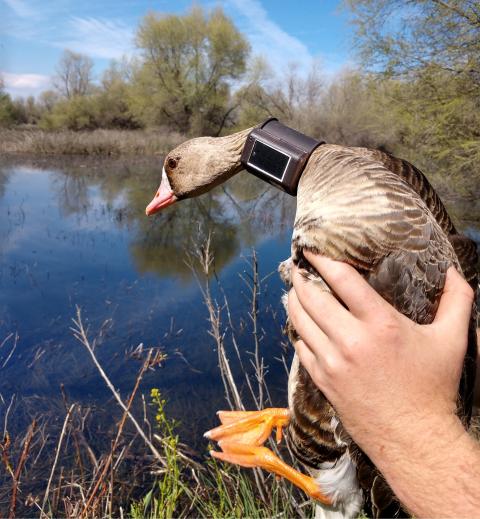
The waterfowl were detected in a wide range of environments. One bar-headed goose flying over the Himalayas experienced temperatures of -27°C, while a mallard in California’s Central Valley experienced temperatures up to 43°C. During winter, birds spent more time near croplands and protected areas, and in summer, they were more likely to live in areas with few people. Their movements also differed dramatically; the average weekly movement distance in winter was 46 km for a snow goose, compared to 3 km for a whooper swan. Each species also varied in how much it moved, depending on the time of year and location.
Waterfowl Habitats
To start to understand why these birds move so differently across space and time, the researchers related the environmental data and species information to the observed movement distances. Despite the diverse species and geographic locations, some common patterns emerged: birds moved farther where landscapes were more uniform, meaning that they would have to fly farther to access all their needs. Birds also moved farther in areas with fewer people, suggesting that waterfowl can adapt to urban and suburban environments by using human-provided resources and becoming more tolerant of people.
Surprisingly, weather had very weak relationships with movement distances, possibly because birds respond more to extreme events than to averages.
Although waterfowl movements explained only a small fraction of the variation in outbreak spread distances for highly pathogenic avian influenza, the link between the two suggests that wild bird movements played a role in these outbreaks – a finding that is supported by genetic information from other studies.
The ONB features articles from Cooperative Fish and Wildlife Research Units across the country. Working with key cooperators, including the Wildlife Management Institute, Units are leading exciting, new fish and wildlife research projects that we believe our readers will appreciate reading about. This article was written by Claire Teitelbaum, cteitelbaum@usgs.gov, Assistant Unit Leader and Adjunct Assistant Professor in the Warnell School of Forestry and Natural Resources at the University of Georgia, and edited by Dawn Childs, dchilds@usgs.gov, USGS Information Specialist.