Outdoor News Bulletin
SECAS: Working Collaboratively Toward a Connected Network of Lands and Waters
The Southeast Conservation Adaptation Strategy (SECAS) brings together public and private organizations around a bold vision for the future of our region. This partnership works to connect the lands and waters of the Southeast and Caribbean to support healthy ecosystems, thriving fish and wildlife populations, and vibrant communities. With a data-driven spatial plan and an ambitious regional goal, SECAS helps accelerate conservation action in the places where it will make the biggest impact.
A Regional Forum for Collaboration
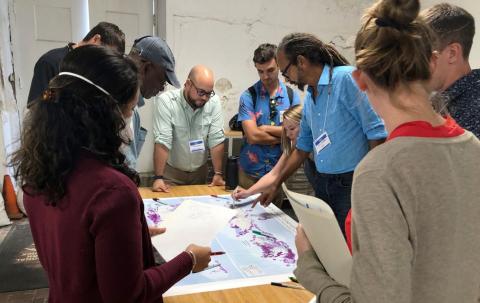
SECAS is a regional conservation partnership started in 2011 by the member states of the Southeast Association of Fish and Wildlife Agencies (SEAFWA) and the federal agencies with natural resource management responsibilities and authorities in the region. The partnership emerged from a collective belief that rising to the conservation challenges of our era will require coordinated action toward common goals. With a geography that includes 15 Southeastern states and two U.S. Caribbean territories, SECAS reflects the culture of collaboration and partnership that define the region’s approach to conservation.
Over its 15-year history, SECAS has brought together a broad suite of partners including state and federal agencies, nonprofit organizations, Tribes, private landowners and businesses, universities, and other partners around a shared vision for the future. This vision – a connected network of lands and waters that supports thriving fish and wildlife populations and improved quality of life for people – guides SECAS’s strategic focus. To date, more than 2,600 people from over 650 different organizations have actively participated in the partnership to advance this vision.
At the highest level, SECAS is governed by an executive-level Steering Committee made up of five state fish and wildlife agency directors and the Southeast U.S. FWS Director. In addition, a group of Points of Contact (POCs) includes representatives from every SEAFWA state and territory, all federal agencies working on natural resources, and nonprofits like The Nature Conservancy and the Native American Fish and Wildlife Society. There are also many structured ways for all people and organizations in the region to provide input into the products and direction of the partnership.
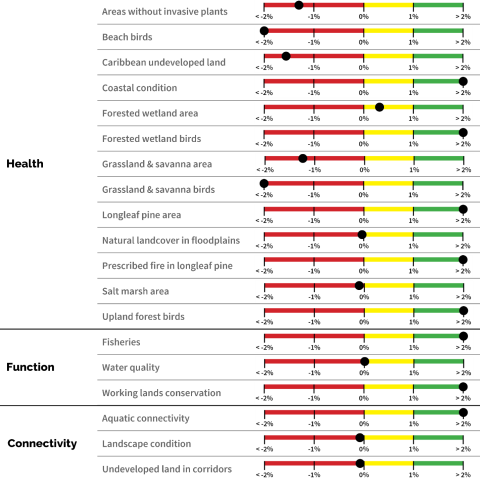
In 2018, SECAS established an ambitious regional goal: a 10% or greater improvement in the health, function, and connectivity of Southeastern ecosystems by 2060. Recognizing the need to track progress along the way, SECAS leadership also worked with SECAS staff and others to develop near-term metrics of success. These metrics are shared through a report SECAS releases every two years called Recent Trends in Southeastern Ecosystems, or the SECAS Goal Report. Drawing on data from existing long-term monitoring programs across the Southeast, the report calculates trends based on indicators of ecosystem health, function, and connectivity.
The SECAS Goal Report offers a snapshot of our collective impact as a conservation community, highlighting successes as well as resources that may be falling through the cracks. The latest findings from the Goal Report show major challenges for grassland and savanna ecosystems, with indicators representing both grassland bird populations and ecosystem extents showing rapid and widespread declines. However, there are signs of hope. Places with significant conservation focus, like the longleaf pine range, show promising improvements, suggesting that coordinated action can make a real difference even in struggling ecosystems. The Goal Report helps SECAS identify regional priorities and rally the conservation community to action. Because they are more off-track for the SECAS Goal than any other ecosystem assessed, grasslands and savannas remain a major priority for SECAS. For example, SECAS helped elevate the importance of grasslands and savannas with national funding sources.
To explore the latest Goal Report:
Developing a Blueprint for Action
The Southeast Conservation Blueprint is the partnership’s plan to achieve the SECAS vision of a connected network of lands and waters. This living priority map is updated annually to reflect the best available science, changing on-the-ground-conditions, and partner priorities. Importantly, this regional strategy is meant to complement, and be used alongside, local planning and information. So far, more than 500 people from over 200 organizations have used the Blueprint in their work. To date, the Blueprint has helped bring in more than $410 million in conservation funding to protect and restore over 410,000 acres.
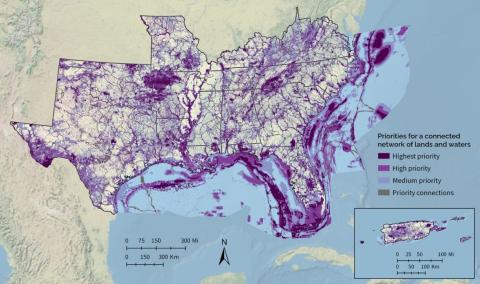
While the Blueprint helps connect actions to a regional strategy and vision, SECAS staff help connect people to the partnership and its tools. SECAS staff offer free assistance and technical support to help strengthen funding proposals, develop maps and custom analyses, write reports and narratives, and help translate science to help inform and advance conservation. This “user support” service is free and open to all. The Blueprint data are also available for partners to use on their own in a number of online formats:
- Start simple in the Blueprint Explorer to discover what’s driving the Blueprint priorities and generate custom reports
- Dig deeper in the SECAS Atlas to overlay the Blueprint with other layer in ArcGIS Online
- Download the GIS data to use in your desktop GIS and access the code and detailed documentation
Catalyzing Conservation in the Right Places to Maximize Impact
The Southeast Conservation Blueprint is being used in numerous ways to help guide conservation action to the places where it will make the biggest impact, and to bring in new resources. From local land trusts conserving strategic tracts, to municipalities developing plans for sustainable growth, to coalitions of states going after national funding sources – SECAS is helping a broad cross-section of the conservation community clear barriers to action.
For example, SECAS staff helped 10 states and two territorial fish and wildlife agencies update their Wildlife Action Plans for the 2025 revision cycle. Working closely with each agency, SECAS staff wrote chapters focused on how each state contributes to the regional landscape and partnerships, and/or by helping identify or revise Conservation Opportunity Areas to improve alignment across boundaries and better sustain shared Species of Greatest Conservation Need.
SECAS staff are also working with the National Fish and Wildlife Foundation (NFWF) to support the Southeast Forests and Rivers Business Plan pilot—the first of 16 NFWF Next Generation Business Plans to be developed nationwide. The plan expands on earlier longleaf pine work to address a broader suite of forest, grassland, and aquatic systems and sets clear, measurable conservation goals over 30 years to align partner investments. SECAS is helping to connect the NFWF Business Plans to existing planning like the Blueprint as well as state priorities like Conservation Opportunity Areas and regionally shared Species of Greatest Conservation Need.
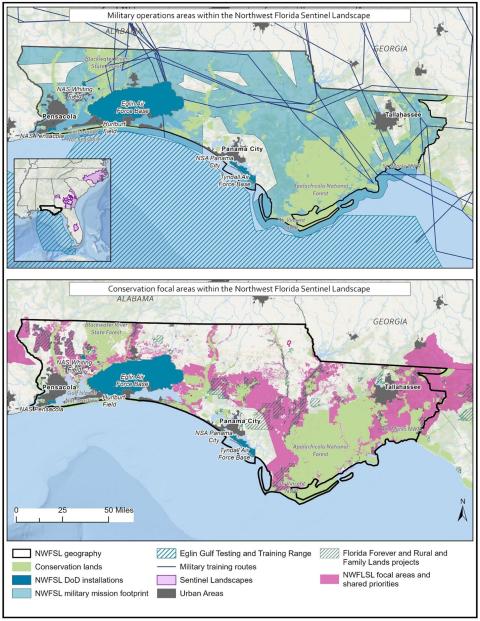
SECAS helps support the military mission as well. The Blueprint has helped support the designation of three Sentinel Landscapes partnerships working at the intersection of national defense, conservation, and working lands. The Blueprint has also helped inform multiple plans by partnerships and military installations intended to help maintain military readiness, achieve conservation goals, sustain working lands, and promote community development. Finally, the Blueprint has helped direct funding for hydrologic restoration on bases to more resilient nature-based solutions in lieu of grey infrastructure.
Working Across Boundaries with Neighboring Regional Initiatives
SECAS continues to collaborate and participate in cross-boundary meetings with regional AFWA conservation efforts, including the Midwest Landscape Initiative, the Northeast Landscape Committee, and WAFWA regional initiatives. With an intent to be unified, not uniform, SECAS works alongside these regions to share knowledge, increase efficiency, and strengthen conservation outcomes across landscapes that transcend regional lines.
Ultimately, SECAS delivers value by providing a forum for the conservation community to collaborate in service of our shared vision and to access science and tools to inform decisions.